Aughentaine Castle and Estate, County Tyrone
Introduction
Aughentaine Castle, situated in County Tyrone, was the principal seat of the Browne family of Aughentaine and Mountstewart, and formed an important part of the network of landed estates connected to the Browne-Lecky and Eccles families.
Construction and Architecture
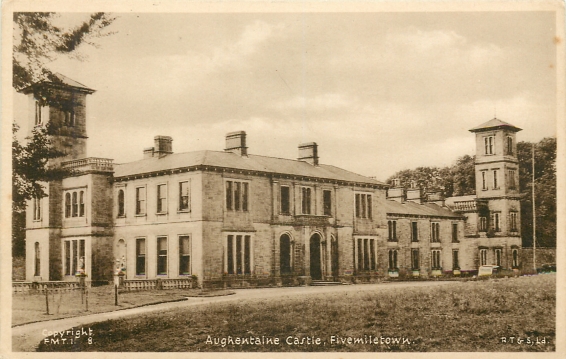
Aughentaine Castle was constructed c.1863 for Thomas Richardson Browne, Esq., to a design by the Dublin architectural firm Isaac & W. R. Farrell. The house was built using stone quarried on the estate itself.
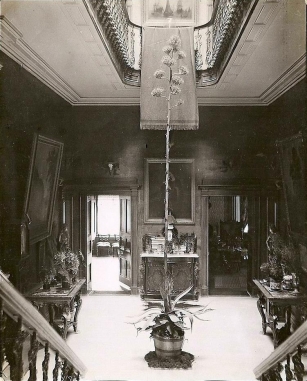
The building comprised a two-storey main block with an adjoining lower wing, and was distinguished by two tall Italianate campaniles of equal height positioned at either end. Architectural features included an open porch and a variety of window forms—both round-headed and rectangular—creating a highly picturesque composition within the Tyrone landscape.
Contemporary Account (1863)
A report from the Belfast Morning News records the house during its construction:
“On Tuesday, the 10th instant, a meeting of the tenantry of the estate and manor of Aughentaine and Mountstewart, the property of Thomas R. Browne, Esq., D.L., J.P., took place at the Castle (Aughentaine), which is in course of erection…
The object of the meeting was to present J. Hervey Browne, Esq., H.M. 12th Royal Lancers, eldest son and heir, on his attaining his majority, with a gold vase…
The tenantry from all parts of this extensive estate were in attendance…”
Source: Belfast Morning News, 23 February 1863
Later History
After several decades in Browne family ownership, the Aughentaine estate was sold c.1955 by Mervyn Knox-Browne, a descendant of Thomas Richardson Browne.
Following the sale, the original castle was demolished by Lieutenant-Colonel John Henry Hamilton-Stubber, who acquired the property. Around 1958, a new neo-classical house was constructed on the site to designs by The Hon. Claud Phillimore.
Historical Significance
Aughentaine formed an important link in the network of interrelated landed families in Tyrone, connecting the Browne, Browne-Lecky, Eccles, and de Montmorency families.
Through this lineage, it forms part of the wider historical context of Ecclesville and the later inheritance of the Browne-Lecky family.
I. BROWNE of Cumber House, Co. Londonderry and Aughentaine Castle, Co. Tyrone
1. John Hamilton Browne
of Cumber House, Co. Londonderry, and Aughentaine Castle, Co. Tyrone
Married Jane Matilda Lecky (b. c.1782, d. 1855), daughter of William Lecky MP of Castlefin, Co. Donegal, and Hannah McCausland of Fruithill (Drenagh), Co. Londonderry.
They had issue:
2. Thomas Richardson Browne
of Cumber House and Aughentaine Castle
Married (1839) Sarah de Montmorency, daughter of Major Harvey Randall Saville Pratt (later de Montmorency) of Castle Morres and Rose Lloyd Kearney.
- d. 29 May 1882
- She d. 1 March 1889
Issue:
2.1. Raymond Saville Browne (-Lecky)
- By Royal Licence, 4 March 1871, assumed the name Lecky in addition to Browne
- d. 20 August 1873, dsp
2.2. Conolly William Lecky Browne
- Married (28 Nov 1878) Anna (Annie) Henrietta Eccles, daughter of Charles Eccles JP DL of Ecclesville and Isabella Blake
- d. 19 Jan 1924
- She d. 8 July 1922
- Had issue (including the Ecclesville line)
2.3. Rose Sarah Browne
- Married Major Robert Conway Dobbs Ellis, of Abbeyfeale, Co. Limerick
- Had issue
2.4. Caroline Frances Browne
- Married (23 May 1871) John Stewart (or Stuart) Eccles
- d. 24 April 1886
- She d. 12 February 1887
- Had issue
2.5. Matilda Theodosia Browne
- Married (11 Dec 1883) Charles Edward Eccles, Captain, Donegal Militia Artillery
- dsp
2.6. Lt.-Col. John Hervey Knox-Browne
- Married Louisa Elizabeth Knox-Gore, daughter of Sir Francis Arthur Knox-Gore, 1st Baronet (19 Dec 1867)
- d. 3 April 1927
- Had issue
II. LECKY and McCAUSLAND ANCESTRY
(Maternal Line of the Browne Family)
1. William Lecky MP
of Castlefin, Co. Donegal
Married Hannah McCausland (b. 3 Oct 1751, d. 26 Aug 1826), daughter of Conolly McCausland of Fruithill (Drenagh), Co. Londonderry.
Issue:
- Jane Matilda Lecky (m. John Hamilton Browne)
2. Conolly McCausland
of Fruithill (Drenagh), Co. Londonderry
- b. 21 Nov 1713
- d. 27 June 1794
Married Elizabeth Gage, daughter of Thomas Gage of Bellarena.
Issue:
- Hannah McCausland (m. William Lecky MP)
3. Col. Robert McCausland
Married (1709) Hannah Moore, whose identity is uncertain:
- Possibly daughter of William Moore of Garvey
- Alternatively identified as daughter of William Conolly
This connection is significant in explaining the inheritance of lands at Limavady.
Extract from the Will of William Conolly (1729)
“I likewise give and bequeath… the Lease… to my Agent Robert McCausland Esq. as an acknowledgement for the faithful service he has done me.”
Source: The National Archives, PROB 11/636/185
III. THE LECKY INHERITANCE
Conolly McCausland Lecky
- d. 17 July 1857
- Married Anne Harvey (no issue)
By his will (29 January 1856), he devised his estates through a complex series of life interests and entail-like limitations involving:
- William Lecky Browne
- Raymond Saville Browne
- Conolly William Lecky Browne
Key Outcome
Following a sequence of deaths:
- 1862 – William Lecky Browne died without issue
- 1873 – Raymond Saville Browne died without issue
- 1874 – Conolly William Lecky Browne assumed the name Lecky
He entered into possession of the Lecky estates
Final Vesting
Upon his death (1924), the estates became vested absolutely in:
Raymond Saville Conolly de Montmorency Lecky Browne-Lecky
The foregoing pedigree illustrates the relationships between the Browne, Lecky, and McCausland families. The transmission of their estates, however, followed a more complex course, governed by wills, settlements, and contingent succession. This is outlined below.
The McCausland and Lecky Inheritance
The later Browne-Lecky inheritance, and its connection to the Ecclesville estate, can only be fully understood through the earlier McCausland and Lecky family lines of County Londonderry.
Col. Robert McCausland and the Conolly Connection
Colonel Robert McCausland, of the Limavady district, married in 1709 Hannah Moore, whose identity remains uncertain.
She may have been:
- the daughter of William Moore of Garvey, and widow of James Hamilton Jr. of Strabane;
- or, according to later family tradition, a daughter of William Conolly
This latter possibility is significant. It offers a plausible explanation for:
- the recurring use of the name Conolly within the McCausland and Lecky families;
- and the connection of the family to lands in the Limavady area.
A suggestive reference appears in the will of William Conolly of Celbridge, dated 18 October 1729:
“I likewise give and bequeath to my said Nephew (Wm Conolly Esq.) his heirs Executors and Administrators respectively all my Leases and Terms for years or lives except only the Lease for years which I hold from the See of Derry in the County of Londonderry which lease I do hereby give and bequeath to my Agent Robert McCausland Esq. his executors and administrators as an Acknowledgement for the faithful service he has done me.”
Source: The National Archives, PROB 11/636/185
The Lecky Line
Through the marriage of Hannah McCausland (daughter of Conolly McCausland of Fruithill, Drenagh) to William Lecky MP of Castlefin, the McCausland inheritance passed into the Lecky family.
Their daughter:
- Jane Matilda Lecky
married John Hamilton Browne of Cumber House and Aughentaine Castle
This marriage united the McCausland–Lecky inheritance with the Browne family of County Tyrone.
Conolly McCausland Lecky and His Will
The most decisive stage in the inheritance occurred with:
Conolly McCausland Lecky,
who died on 17 July 1857 without issue.
By his will dated 29 January 1856, he devised his estates through a complex system of life interests and contingent succession, primarily in favour of his Browne relatives.
The structure of the settlement may be summarised as follows:
- The estate was first held for the benefit of his widow for life;
- Thereafter, it passed to William Lecky Browne for life;
- Then to Raymond Saville Browne (second son of Thomas Richardson Browne);
- With provisions that, if he inherited Aughentaine or died without issue, the estate would pass instead to:
- Conolly William Lecky Browne
The will further provided for strict succession through male lines, reflecting a structure similar in effect to an entail.
Outcome of the Settlement
A sequence of early deaths altered the intended line of succession:
- 1862 – William Lecky Browne died without issue
- 1873 – Raymond Saville Browne died unmarried and without issue
- 1874 – Conolly William Browne assumed the additional surname Lecky by Royal Licence
He thereupon entered into possession of the Lecky estates.
Final Vesting of the Estate
Upon the death of Conolly William Lecky Browne-Lecky in 1924, the estates passed absolutely to his son:
Raymond Saville Conolly de Montmorency Lecky Browne-Lecky
This marked the final consolidation of multiple family inheritances, combining:
- McCausland (Drenagh)
- Lecky (Castlefin)
- Browne (Aughentaine)
- de Montmorency (Castle Morres)
- Eccles (Ecclesville)
into a single line.
Historical Significance
This chain of inheritance represents one of the most intricate examples of estate transmission among the Irish landed gentry.
It illustrates:
- the importance of strategic marriage alliances;
- the use of wills and quasi-entail structures to control succession;
- and the gradual consolidation of estates across multiple counties into a single inheriting line.
See also: