
Ecclesville House, Fintona, County Tyrone
Seat of the Eccles Family
Ecclesville House was the seat of the Eccles family in County Tyrone and formed the centre of the Ecclesville estate near Fintona.
The estate developed from lands at Fentonagh acquired by the Eccles family during the later seventeenth century, which were gradually consolidated into a substantial landed property centred upon Ecclesville.
Over successive generations, Ecclesville became closely associated with the family’s identity and standing, forming one of the principal estates in the locality.
Development of the House
The original manor house at Ecclesville was constructed in 1703 as the seat of the Eccles family near Fintona, County Tyrone.
The house was enlarged in 1795, reflecting the increasing prosperity and status of the family during the late eighteenth century.
Further extensions were carried out in 1825 by:
John Dickson Eccles
under whose ownership Ecclesville developed into one of the principal country houses of the district.
Over successive generations the house formed the centre of the Ecclesville estate and remained closely associated with the Eccles, Browne-Lecky, and later McClintock family connections.
The Eccles Family at Ecclesville
The Eccles family established their position through the acquisition and expansion of landholdings in the Fintona district.
By the eighteenth century, Ecclesville had emerged as the principal residence of the family and remained so for generations. Members of the family served as High Sheriffs and held prominent positions within local society and county administration.
The estate passed through several generations of the Eccles family before eventually becoming connected to the McClintock family through marriage.
Relationship to Seskinore
Ecclesville became linked to Seskinore through the marriage of:
Amy Henrietta Frances Eccles
eldest daughter and co-heiress of John Stuart Eccles of Ecclesville,
to
Colonel John (“Jack”) Knox McClintock
of Seskinore, in 1893.
The marriage united two significant Tyrone landed families and created a close connection between the two estates.
However, despite this family relationship, Ecclesville and Seskinore remained legally distinct properties.
Had a male heir been born to the marriage, Ecclesville might ultimately have passed into the same line as Seskinore. In the absence of such an heir, the estates followed separate lines of succession.
Ecclesville was governed by an entail in tail male and therefore did not pass into the McClintock succession.
See: Will of John Stewart (or Stuart) Eccles and the Entail of Ecclesville
The House and Demesne in the Twentieth Century
During the Irish Land Commission sales of the early twentieth century, much of the wider Ecclesville estate was transferred to occupying tenants under the Irish Land Acts.
However, the Ecclesville demesne — including the house and surrounding lands — was retained separately.
Land Registry records dated 1921 confirm that:
Amy Henrietta Frances McClintock (née Eccles)
repurchased part of the Ecclesville demesne from the Irish Land Commission as demesne lands, comprising approximately:
- 208 acres
- 3 roods
- 20 perches
The records describe the transaction as:
“Re-purchase of Demesne Lands by Vendor”
and confirm Amy H. McClintock as owner in fee simple.
This demonstrates that, although the wider estate was broken up under the Land Acts, the core demesne and house remained in private ownership.
Raymond Browne-Lecky and the Final Ownership
The Ecclesville demesne later passed into the ownership of:
Raymond Saville Connolly de Montmorency Lecky Browne-Lecky
a cousin of Amy McClintock through the Browne-Lecky and Eccles connections.
Land Registry folios subsequently record Raymond Browne-Lecky as registered owner of the Ecclesville demesne lands.
He became the final private owner associated with Ecclesville House before the later decline and dispersal of the estate.
The surviving demesne therefore passed through several overlapping phases of ownership:
- the original Eccles family estate
- the McClintock connection through Amy Eccles
- the later Browne-Lecky ownership
Together these transitions reflect the wider transformation of Irish landed estates during the twentieth century.
Decline of the Estate
Like many Irish country houses, Ecclesville experienced gradual decline during the twentieth century as the traditional landed estate system came under increasing financial and political pressure.
The sale of lands under the Irish Land Acts fundamentally altered the structure of the estate, reducing what had once been a substantial landed property to a smaller surviving demesne.
Its later history reflects the broader story of many Ulster estates during this period — the fragmentation of landownership, the disappearance of large estate systems, and the gradual decline of many country houses associated with them.
Land Registry Records
1921 Demesne Re-purchase
Land Registry records dated 3 June 1921 record the repurchase of part of the Ecclesville demesne by Amy H. McClintock from the Irish Land Commission.
The records confirm the retention of the core demesne lands separately from the wider estate sales.
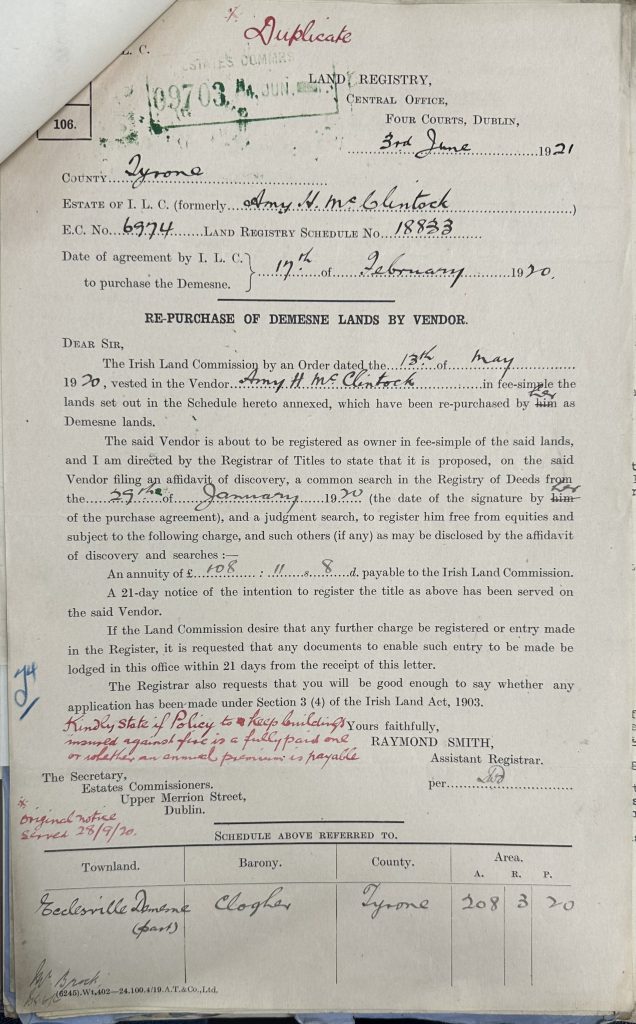
Caption:
Land Registry document recording the repurchase of the Ecclesville demesne by Amy H. McClintock following the Irish Land Commission sales.
Raymond Saville Conolly de Montmorency Lecky Browne-Lecky Ownership Folio
Subsequent Land Registry folios record Raymond Saville Connolly de Montmorency Lecky Browne-Lecky as owner of the Ecclesville demesne.
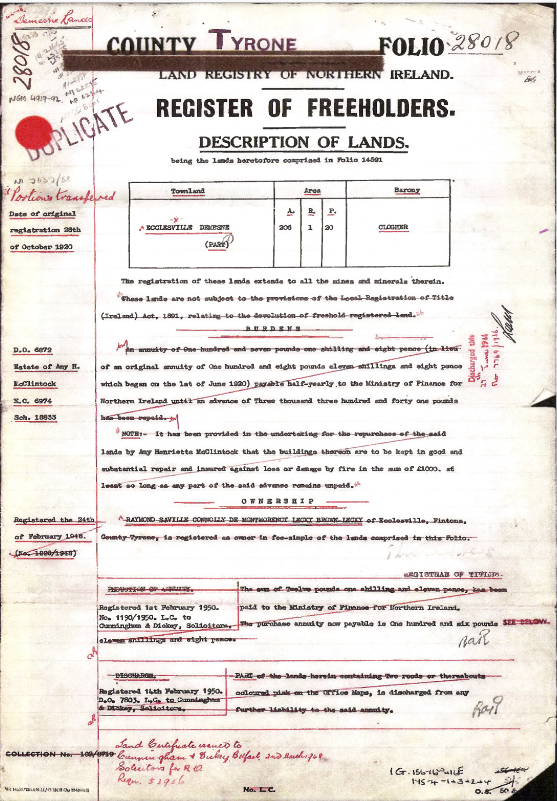
Caption:
Land Registry folio recording Raymond Browne-Lecky as owner of the Ecclesville demesne.
Raymond Browne-Lecky and the Final Years of Ecclesville
During the mid-twentieth century, Ecclesville remained associated with:
Raymond Saville Conolly de Montmorency Lecky-Browne-Lecky
often known socially as “Tibby”.
A contemporary architectural directory described Ecclesville as:
“Ecclesville, Fintona, co Tyrone … A plain late-Georgian house. The home of Raymond Saville Charles De Montmorency (“Tibby”) Lecky-Browne-Lecky, actor-musician and noted female impersonator.”
The entry appears to contain an error, incorrectly giving Raymond’s second name as “Charles” rather than “Conolly”.
By the later twentieth century the house had ceased to function as a private landed residence and was subsequently converted into a residential home.