Ecclesville Estate: Ownership Timeline
Succession, Ownership, and Final Disposition

Introduction
The ownership of Ecclesville reflects a complex transition from a seventeenth-century landed estate to a reduced twentieth-century demesne, shaped by inheritance law, family interconnection, and land reform.
This timeline traces the succession of ownership from the Eccles family through to the final transfer to the Government of Northern Ireland and the eventual demolition of the house.
Key Dates
- 1660s – Eccles family established in County Tyrone
- c.1703 – Ecclesville House constructed
- 1873 – Entail created by John Stewart (or Stuart) Eccles
- 1886 – Death of John Stewart (or Stuart) Eccles
- c.1900–1913 – Break-up of estate under Land Acts
- c.1909–1924 – Browne-Lecky acquisition of demesne
- 1961 – Death of Raymond Browne-Lecky
- 1962 – Auction of contents
- 1969 – Land Registry records demesne (194 acres)
- 1978 – Demolition of Ecclesville House
Seventeenth and Eighteenth Centuries: Eccles Foundation
c.1660s–1694
Gilbert Eccles (d.1694) established the Eccles family in County Tyrone, acquiring lands at Fentonagh (Castleleigh), forming the basis of the Ecclesville estate.
c.1703–1726
Charles Eccles (d.1726), his son, built Ecclesville House and established the family seat.
Throughout the eighteenth century, successive generations of the Eccles family consolidated the estate and expanded their local influence.
Nineteenth Century: Mature Estate
During the nineteenth century, Ecclesville developed into a substantial and well-defined landed estate.
Ownership passed through successive generations to:
JOHN STEWART (OR STUART) ECCLES (d.1886)
Under his tenure, the estate reached its fullest extent, both in landholding and social standing.
1873–1886: The Entail
In 1873, John Stewart (or Stuart) Eccles executed a will placing the estate under an entail in tail male.
This meant:
- inheritance was restricted to male heirs
- the estate could not pass freely through the female line
Upon his death in 1886:
- no surviving male heir existed
- his daughter, Amy Eccles, became life tenant only
The estate was therefore legally destined to pass outside her direct line.
1886–c.1900: Transitional Occupation
Amy Henrietta Frances Eccles (later McClintock) occupied Ecclesville as life tenant.
In 1893, she married Colonel John Knox McClintock of Seskinore.
By c.1899, the family had removed to Seskinore, and Ecclesville entered a period of transition in both occupation and management.
c.1900–1913: Break-Up of the Estate
Under the Irish Land Acts:
- tenants purchased their holdings
- the estate was progressively dismantled
- the traditional landlord system collapsed
By 1913:
- the estate was submitted to the Land Commission
- only the house and its demesne remained
Ecclesville ceased to exist as a large landed estate.
c.1909–1924: Browne-Lecky Occupation and Transition
During the early twentieth century, Ecclesville House and its remaining demesne became increasingly associated with the Browne-Lecky family through the Eccles connection.
By at least the 1910s, Conolly William Lecky Browne-Lecky and his wife, Annie Henrietta Browne-Lecky (née Eccles), were resident at Ecclesville. However, Amy Henrietta Frances Eccles McClintock remained legally associated with the estate and was registered in fee of the demesne in 1921.
The precise legal transition of the demesne into Browne-Lecky ownership remains somewhat unclear, reflecting the complex overlap of family occupation, inheritance arrangements, and estate administration following the break-up of the wider estate under the Land Acts.
This period marked the gradual transition of Ecclesville:
- from a landed estate to a reduced private demesne
- from direct Eccles family occupation to Browne-Lecky association
- and from estate administration toward private residential ownership
1924–1961: Raymond Browne-Lecky
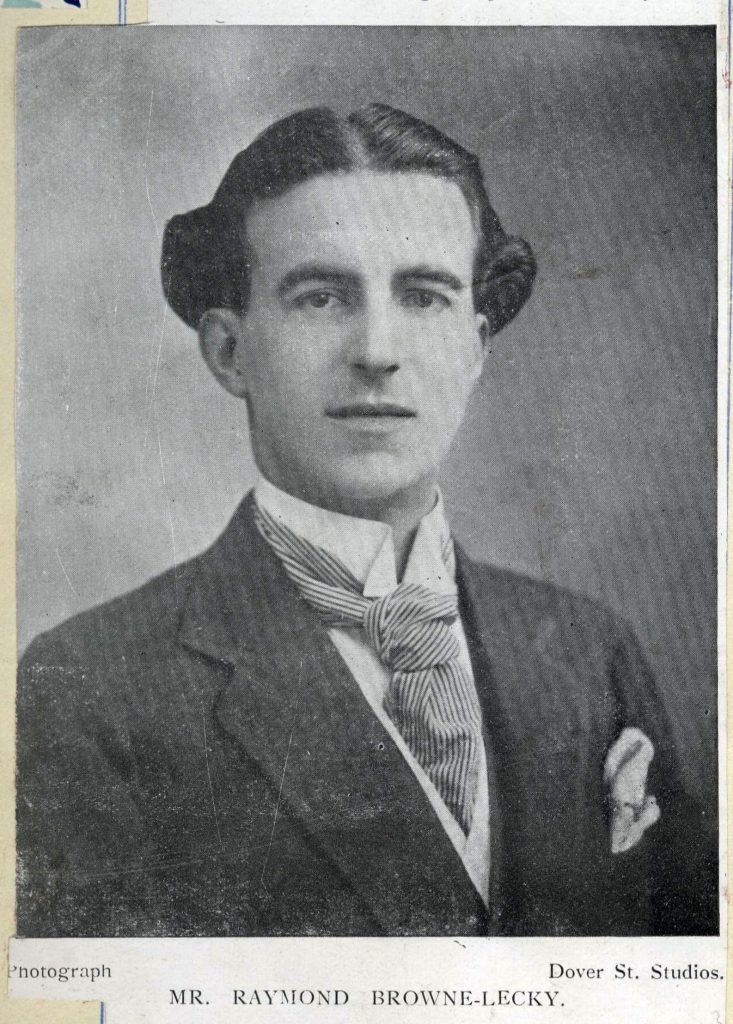
Following the death of Conolly Browne-Lecky in 1924, ownership passed to:
Raymond Saville Conolly de Montmorency Lecky Browne-Lecky (1881–1961)
Under his ownership:
- Ecclesville functioned as a private residence
- The demesne remained intact
- The wider estate no longer existed
1961–1962: Transfer to the State
Raymond Browne-Lecky died on 11 November 1961.
By his will:
- Ecclesville House and demesne were bequeathed to the Government of Northern Ireland
In 1962:
- The contents of the house were sold at auction
- The house became vacant
1962–1969: State Ownership Formalised
A Land Registry folio (No. 28018), certified in 1969, records Ecclesville Demesne as comprising:
194 acres, 1 rood, 243 square yards
The registered owner is given as:
The Ministry of Agriculture for Northern Ireland
This confirms that, although the wider estate had been dismantled, the core demesne remained largely intact into the mid-twentieth century.
1978: Demolition
In 1978, Ecclesville House was demolished, bringing to an end over two centuries of continuous occupation.
Summary of Ownership Phases
Eccles Family Estate (c.1660s–1886)
A substantial landed estate established and developed over two centuries
Entailed Estate (1886–c.1900)
Life tenancy under Amy Eccles, with inheritance legally restricted
Land Commission Break-Up (c.1900–1913)
Progressive sale of lands and dissolution of the estate
Browne-Lecky Demesne (c.1909–1961)
Private ownership of the house and reduced lands
State Ownership (1961–1978)
Government control, abandonment, and eventual demolition
Historical Significance
The ownership history of Ecclesville illustrates:
- The rise of a Plantation-era landed estate
- The restrictive impact of entail
- The transformative effect of the Irish Land Acts
- The transition from estate to private residence
- The final decline of the country house in the twentieth century
See Also
- Ecclesville House, Fintona
- The Break-Up of the Ecclesville Estate
- Disentailing of the Ecclesville Estate (1944)
- Final Attempts to Save Ecclesville (1961–1962)
- Ecclesville Auction Catalogue (1962)
- Raymond Browne-Lecky (1881–1961)