
Later Years of Ecclesville House
From McClintock Occupation to Browne-Lecky Ownership
Amy Henrietta Frances McClintock (née Eccles) and her husband, John Knox McClintock, resided at Ecclesville House until c.1899, when they removed to Seskinore House.
Around this time, Colonel H. G. S. (“Harry”) Alexander, uncle of John Knox McClintock and agent of the Seskinore Estate, took up residence at Ecclesville and assumed management of the estate. The Alexanders later vacated the house and returned to Carrickmore House, Termon.
The Browne-Lecky Acquisition
By c.1909, Ecclesville entered a new phase of occupation.
Amy’s maternal uncle, Conolly William Lecky Browne-Lecky, together with her paternal aunt Annie Browne-Lecky (née Eccles), acquired the demesne under the provisions of the Irish Land Commission.
This purchase comprised:
- Ecclesville House
- The demesne (206 acres, 1 rood, 20 perches)
This marked the final transformation of Ecclesville from a large landed estate into a reduced private demesne.
The Browne-Leckys divided their time between Ecclesville and Fintimara, Rostrevor, County Down, as well as residences in Dublin, Portrush, and on the Continent. Fintimara was sold c.1919.
Their son, Raymond Browne-Lecky, brought a cultural dimension to the house. A private theatre was constructed in the west wing, where he staged dramatic productions and musical performances, often for charitable purposes.
Scandal and Separation: Amy Eccles McClintock
Around 1916, during the First World War, a personal crisis altered the course of the family’s history.
While serving in Londonderry as commander of the 3rd Battalion, Royal Inniskilling Fusiliers, Colonel McClintock became aware of his wife’s involvement in an affair. He returned unexpectedly to Ecclesville, where the situation was dramatically confronted.
Contemporary accounts—later corroborated by Rosalie McClintock (née Orr)—identified the man involved as George Fleming of Omagh.
Following this episode:
- Amy was permanently separated from her husband
- She was excluded from the family and estate
- She left Ireland and settled in England
She lived initially near her sister Dosie in Gloucestershire, later at Effingham, Surrey.
Amy died on 4 April 1942 and was buried at St. Lawrence Churchyard, Effingham. Her sister Anna Theodosia Hester Stoney (Dosie) was later interred in the same grave.
“Life is eternal and love immortal.”
The Delmege Inheritance (Under the Entail)
Under the terms of the 1873 will of John Stuart Eccles, the estate was entailed in tail male through the daughters.
Although not the eldest daughter, Rose Eccles’s line produced the first qualifying male heir:
Anthony Charles Stuart Delmege

Born 1 December 1910, he was the son of Major Carfrae Hamilton Delmege and Rose Eccles.
He:
- Became tenant in tail male under the entail
- Served as a Colonel in the 1st King’s Dragoon Guards
- Acted as Aide-de-Camp to the Governor of Madras
He remained unmarried and died on 22 July 1961.
A visit to Ecclesville in 1951 marked a symbolic return of the entailed line to its ancestral estate.

The Final Years of Ecclesville
The Final Years of Ecclesville
Raymond Browne-Lecky, who had inherited Ecclesville in 1924, died on 11 November 1961.
By his will, he bequeathed the house and demesne to the Government of Northern Ireland, subject to conditions relating to death duties.
The contents of the house—collected over nearly three centuries—were sold at auction in February 1962, bringing to an end Ecclesville as a lived house.
Subsequent efforts to secure a future for the property were unsuccessful.
Ecclesville House was ultimately demolished in 1978, ending over 250 years of continuous occupation.
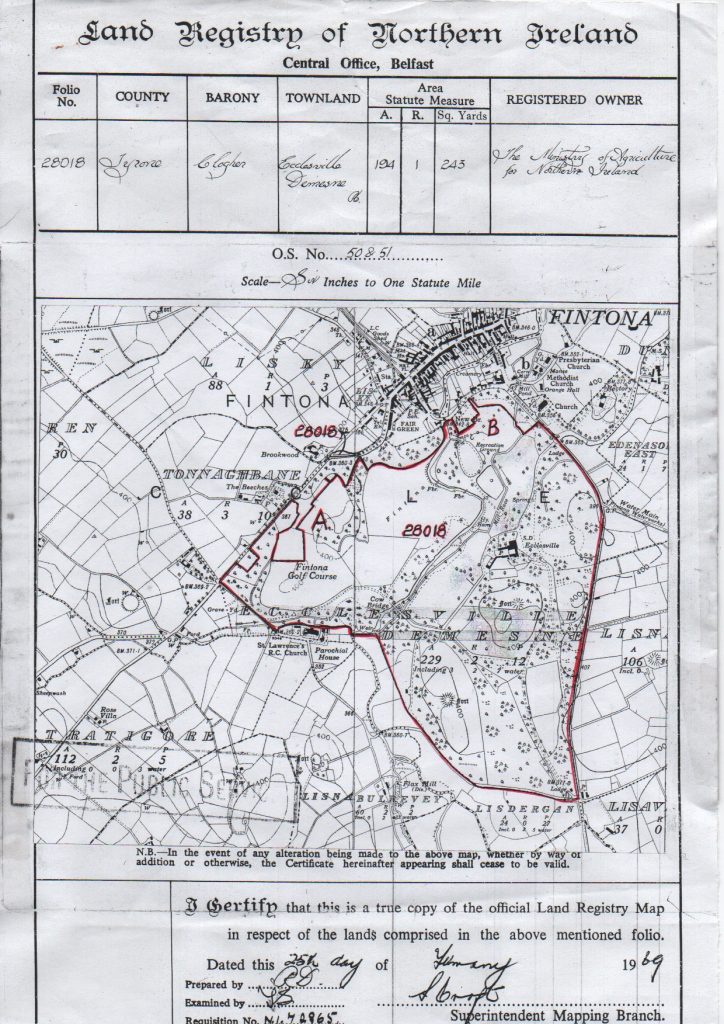
The Final Demesne: Land Registry Record
A Land Registry folio (No. 28018), certified in 1969, records the Ecclesville demesne as comprising:
194 acres, 1 rood, 243 square yards
By this date, ownership had passed to:
The Ministry of Agriculture for Northern Ireland
This confirms that, although the wider estate had long been broken up under the Land Acts, the core demesne remained largely intact into the mid-twentieth century.
Historical Significance
The later history of Ecclesville reflects the wider trajectory of the Irish landed class:
- Estate fragmentation under the Land Acts
- Legal rigidity of entail versus social change
- Transition from landlordism to private demesne
- Final dissolution under economic and administrative realities
What remains is not the estate itself, but its historical imprint—preserved through records, family connections, and the landscape of Fintona.
See also: