Penelope (“Xenia”) Joynson-Wreford
Introduction

Penelope (“Xenia”) Joynson-Wreford represents the final generational link to the Seskinore estate and played a central role in its rediscovery in the early twenty-first century.
Though heir to a long-established estate, her life was shaped not by continuity, but by separation, distance, and eventual rediscovery.
Through her, the story of Seskinore moved from private inheritance into historical recovery and preservation.
Chronology
- 3 August 1935 — Born at Leatherhead, Surrey, to Amelia Isobel Eccles Joynson-Wreford (“Leila”) and Captain Wilfred Heyman (“Tony”) Joynson-Wreford.
- 24 October 1936 — Death of her grandfather, Colonel John Knox McClintock, at Seskinore.
- January 1937 — Returned with her parents to Seskinore following Colonel McClintock’s death.
- 30 January 1937 — Death of her mother, Leila Joynson-Wreford (née McClintock), from meningitis at Seskinore.
- 1937–1938 — Settlement and conveyance of the remaining Seskinore estate completed; estate lands, mansion house and investments passed to Captain Wilfred Heyman Joynson-Wreford.
- 23 March 1940 — Death of her father, Captain Wilfred Heyman (“Tony”) Joynson-Wreford, at Clavadel, Switzerland.
- 4 April 1942 — Death of her grandmother, Amy Henrietta Frances Eccles McClintock.
- 1940s — Sale and dispersal of the contents of Seskinore House and continuing fragmentation of the estate.
- 1952 — Demolition of Seskinore House.
- September 2005 — Returned to Seskinore for the first time since childhood.
- 2005–2008 — Renewed family connection with Seskinore through visits, research and the rediscovery of estate history.
- 2012 — Final return visit to Seskinore with her half-brother, Anthony Patrick (“Pat”) Joynson-Wreford.
- August 2015 — Death of Anthony Patrick (“Pat”) Joynson-Wreford; his ashes were later interred in the Garden of Remembrance at Seskinore.
- 2018–2019 — Sale of McClintock Primary School, ending the last operational institution carrying the McClintock name in Seskinore.
- Present — Continues to represent the final direct descendant of Colonel John Knox McClintock and Amelia (“Leila”) Isobel Eccles McClintock associated with Seskinore, and remains central to the preservation, interpretation and rediscovery of the estate’s history.
Early Life and Separation
Born on 3 August 1935, Xenia was only a small child when both parents died within three years of one another.
Following these losses, her connection to Seskinore was effectively broken in childhood. Raised under guardianship and educated away from Ireland, she grew up largely unaware of the full extent of her family history and inheritance.
The estate itself was sold and dispersed during this period, removing the physical and social foundations that had once defined the family’s position.
Her childhood was marked by loss, distance, and fragmentation — circumstances that would shape much of her later life.
Following the death of her mother in 1937, provision had to be made for Xenia’s future care. In his will of 1939, Tony Joynson-Wreford appointed his cousin Anthony Charles Stuart Delmege as Xenia’s guardian in the event of his death. Shortly before Tony died in 1940, the appointment was revoked by codicil and transferred to John and Sheila Botler of Sussex. The change occurred during the early months of the Second World War while Anthony was serving with the King’s Dragoon Guards.
Godparents and Early Family Connections
One of Xenia’s godparents was Carfrae (“Hamilton”) Delmege, husband of Rose Isabel de Montmorency Eccles and father of Anthony Charles Stuart Delmege.
Family tradition suggests that Xenia’s christening took place in Switzerland during her parents’ residence there in the mid-1930s.
A silver christening bowl presented by Hamilton Delmege survives within the family and bears the inscription:
“Penelope Xenia
from her Godfather
Hamilton Delmege”
The gift provides a tangible reminder of the close relationship between the Joynson-Wreford, Eccles and Delmege families during Xenia’s early childhood.
This also helps explain why Anthony Charles Stuart Delmege was later chosen by Tony Joynson-Wreford as Xenia’s proposed guardian.
Life Beyond Seskinore
During the post-war decades, Xenia built a life far removed from the world into which she had been born.
Travel, marriage, and life abroad — particularly in India and later Australia — shaped a path defined by independence rather than inheritance.
Her life reflects a broader transition experienced by many families of similar background: a movement away from landed identity toward new, self-defined roles in a changing world.
Although physically distant from Seskinore, the connection was never entirely lost.
Rediscovery of Seskinore
Beginning around 2004–2005, the story of Seskinore gradually began to be reconstructed through archival research, estate documentation, and renewed family contact.
During this process, Xenia was reconnected not only with her inheritance, but with a wider family history that had become obscured over time.
One of the most significant developments was the rediscovery of her half-brother:
Anthony (“Pat”) Patrick Joynson-Wreford
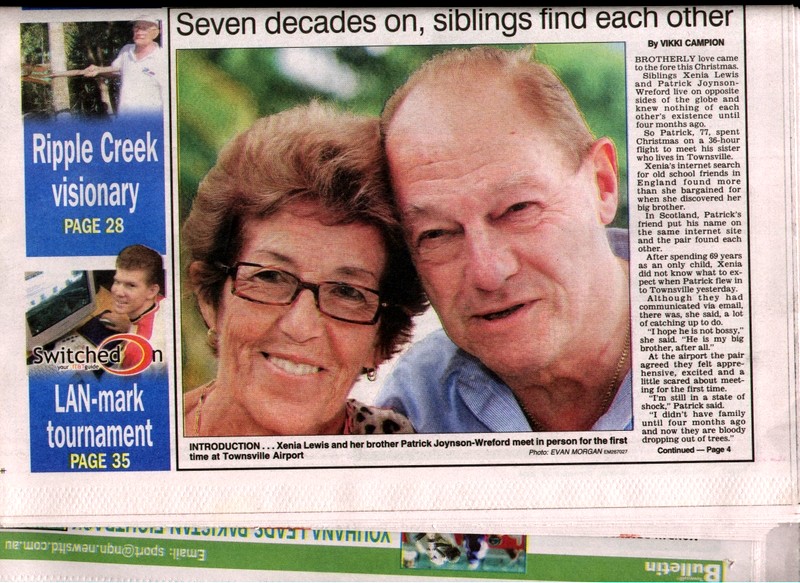
whose existence had long remained largely unknown within the wider family narrative.
The reunion between Pat and Xenia restored an important broken connection within the family and became central to the later recovery of the Seskinore story.
At the same time:
- estate records were recovered
- surviving landholdings identified
- family archives assembled
- and long-forgotten relationships renewed.
Return to Seskinore
Xenia’s return to Seskinore in 2005 marked a profound moment in the modern history of the estate.
Although Seskinore House itself had long since been demolished, the surviving landscape retained enormous emotional significance.
The village, demesne, woodland, and Garden of Remembrance continued to preserve traces of the family’s past.
The return represented not a restoration of landed ownership in the old sense, but a reconnection with memory, identity, and place.
Subsequent visits deepened this process and helped establish renewed relationships with local residents and surviving family connections.
Family Reunions and Rediscovered Connections
The rediscovery of Seskinore also led to the renewal of wider family connections across Britain and Ireland.
During visits to Surrey, Xenia met relatives connected through the McClintock and Stewart families, including:
- Julia Chessun (née Mathews)
- descendants of Celeste Ray
- and other branches of the extended family.
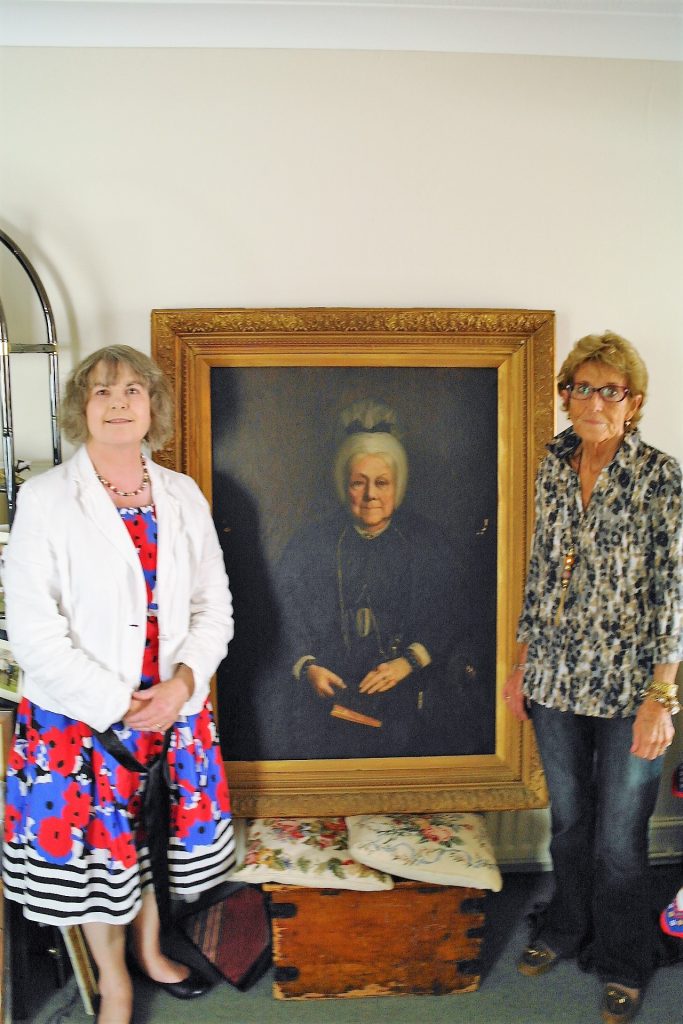
Historic photographs, letters, and portraits were shared and preserved as part of the growing family archive.
Further visits to Somerset brought renewed contact with:
Sir David Stewart, 7th Baronet of Athenree
and Lady Bridget Stewart.
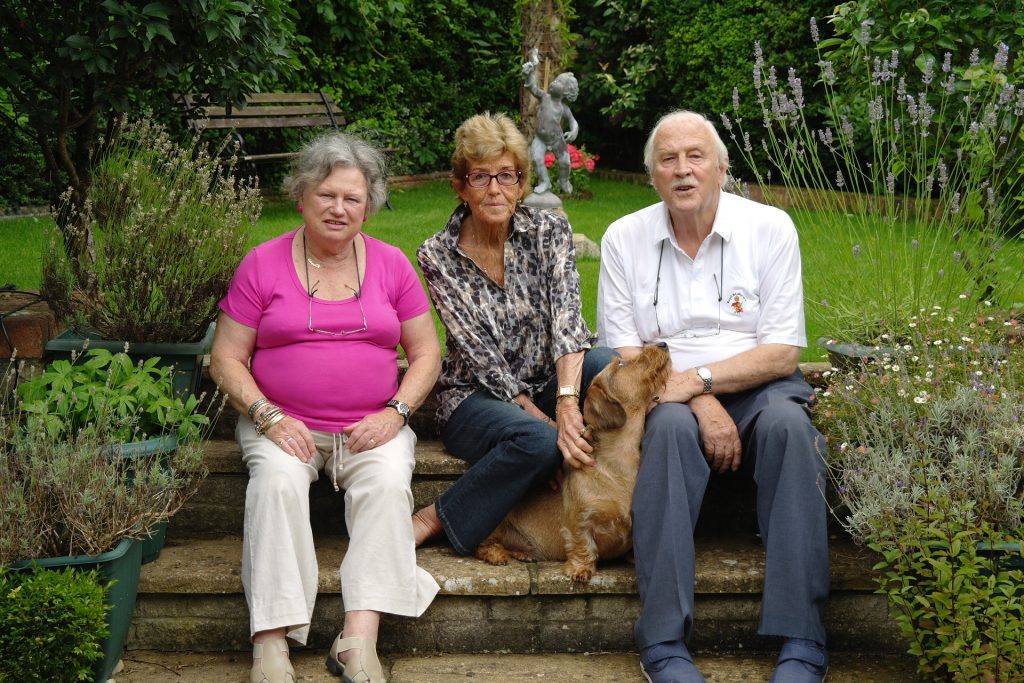
Xenia, with David, Bridget and Oofie.
These meetings helped reconnect branches of families whose relationships had been interrupted for decades by distance, death, and changing circumstances.
They also contributed significantly to the recovery of historical material relating to:
- the McClintock family
- Stewart of Athenree
- and the wider Seskinore network.
Family Origins and Connections
For a detailed account of Xenia Joynson-Wreford’s ancestry and the interconnected families of Seskinore, Mullaghmore, Ecclesville, Aughentaine Castle and the Joynson-Wreford family, see:
Penelope (“Xenia”) Joynson-Wreford: Ancestors and Connected Families
Pat Joynson-Wreford’s Illness and Final Years
In 2012, concerns began to emerge regarding Pat Joynson-Wreford’s health.
After several troubling incidents, he was diagnosed with Alzheimer’s disease in May of that year.
Although medication initially helped stabilise his condition, the illness gradually progressed.
Later that summer, Xenia travelled from Australia to Scotland, and together with family members made what would become their final shared visit to Seskinore.
Despite the challenges created by Pat’s illness, the visit remained deeply meaningful.
The surviving estate landscape — particularly the Garden of Remembrance — continued to hold enormous emotional significance for both Pat and Xenia.
In October 2012, Pat suffered a serious fall and subsequently entered:
Westerton Care Home, Bearsden
where he remained during his final years.
He died peacefully in August 2015 at the age of 87.
In accordance with his wishes, his ashes were interred beside those of his father within the:
Garden of Remembrance at Seskinore
restoring, in some measure, a family connection that had once seemed permanently broken.
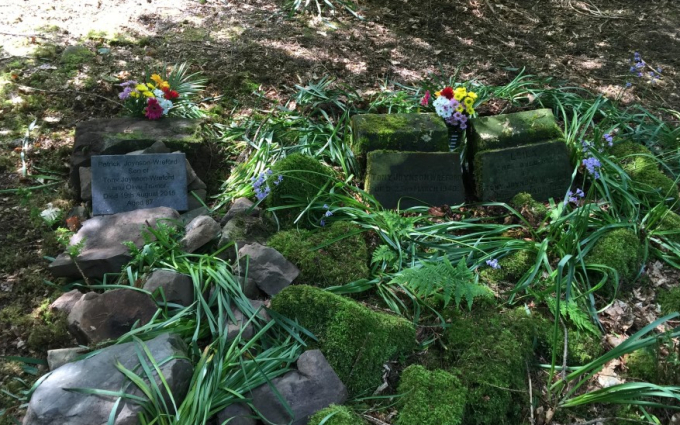
The Final Passing of the McClintock Generation
Although Xenia lost both parents in childhood, one direct link with the earlier Seskinore world survived for a few more years in her grandmother, Amy Henrietta Frances Eccles McClintock.
Amy outlived Colonel John Knox McClintock, Leila, and Tony Joynson-Wreford. Following her death at Effingham, Surrey, on 4 April 1942, the final legal and probate arrangements connected with the McClintock succession were completed.
The probate records identify Xenia as the sole surviving child of Amelia (“Leila”) Isobel Eccles McClintock and therefore the remaining representative of Amy Henrietta Frances Eccles McClintock’s direct line. With Amy’s death, the legal succession created by the McClintock marriage settlement of 1893 finally came to an end.
Passing of Responsibility
As the recovery of the estate history progressed, responsibility increasingly passed into Xenia’s own hands.
Research materials, estate papers, title documentation, correspondence, and archival information relating to Seskinore were assembled and transferred to her stewardship.
This represented an important transition:
from recovery and rediscovery toward preservation and continuity.
The surviving historical record of Seskinore had effectively been reconstructed.
The Sale of McClintock Primary School
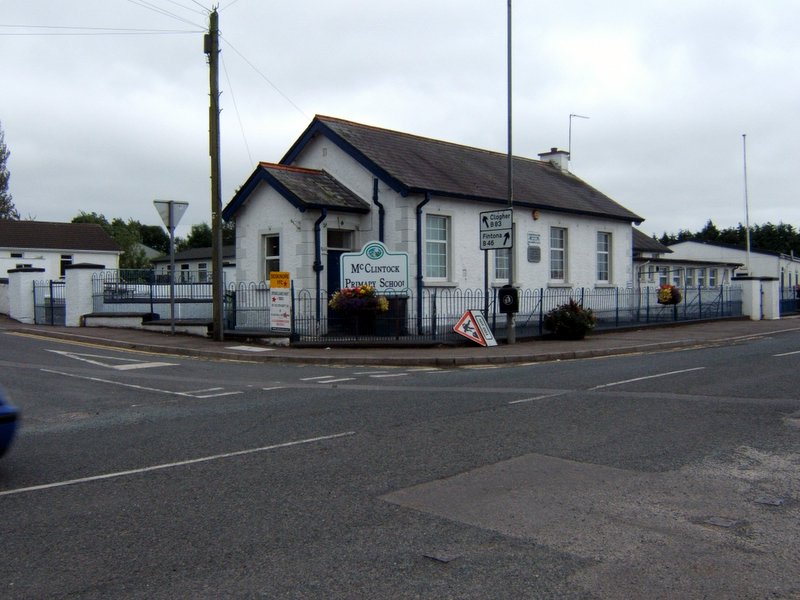
One of the final surviving operational links between the Perry–McClintock family and the village of Seskinore was:
McClintock Primary School
originally established by Colonel John Knox McClintock in 1900.
The school remained associated with the family for many years under lease arrangements.
In 2018–19, the school was finally sold.
With this sale, the last direct operational connection between the family and the village formally came to an end.
After nearly three centuries, the estate lands and institutions once central to village life had fully passed out of family ownership.
Legacy
Seskinore House has disappeared, and the estate no longer survives in its original form.
Yet its legacy endures.
It remains present in:
- archival records and research
- surviving estate landscapes
- the village and demesne
- the Garden of Remembrance
- and in family and local memory.
What was once a private landed estate has gradually become a shared historical landscape.
The story of Seskinore is therefore not simply one of inheritance and decline.
It is also a story of:
- continuity and loss
- separation and rediscovery
- and the enduring relationship between people, memory, and place.
From the Perrys of Mullaghmore, to the McClintocks of Seskinore, and finally to the Joynson-Wreford family, the thread of continuity was never entirely broken.
Through Xenia’s rediscovery of Seskinore, together with the assistance of family members, researchers and the local community, a substantial body of estate history, photographs, documents and family records has been recovered and preserved for future generations.
The Estate Today
Although Seskinore House itself has long vanished, important elements of the estate landscape survive.
In recent years, the:
Seskinore Rural Community Group
has worked actively to preserve and restore surviving estate buildings and features associated with the former demesne.
Through conservation work, fundraising, and community initiatives, the group has helped ensure that important aspects of the estate continue to survive within the local landscape.
The aim has not simply been preservation alone, but the creation of a renewed community asset connected to the historic character of the estate.
In this way, Seskinore continues to evolve.
What was once a private landed estate has increasingly become a shared landscape — one in which history, memory, and community remain closely intertwined.
Related Articles
Seskinore & Rediscovery
- Xenia’s Early Life: Guardianship, Separation and Silence
- Xenia’s Life Beyond Seskinore: India, Australia and Independence
- Xenia’s Return to Seskinore (2005)
- The Recovery of the Seskinore Estate (2005–2007)
- Seskinore Revisited (2005): A Personal Account
- Return to Seskinore (2008): Memory, Restoration and Reunion
- The Garden of Remembrance at Seskinore
Family Connections
- Amy Henrietta Frances Eccles (1874–1942)
- Will of Amy Henrietta Frances Eccles McClintock (1942)
- Amelia (“Leila”) Isobel Eccles McClintock
- Captain Wilfred (“Tony”) Heyman Joynson-Wreford
- Anthony Patrick (“Pat”) Joynson-Wreford
- Penelope (“Xenia”) Joynson-Wreford: Ancestors and Connected Families
- McClintock of Seskinore: Perry Descent and Pedigree
- The Stewart Family of Athenree, Ballygawley and Loughmacrory
- The Peacocke–McClintock–Stewart Connection