Introduction
The recovery of the Seskinore estate began, quite unexpectedly, with a simple enquiry.
In early 2005, my curiosity about Xenia’s family led me to make enquiries at Omagh Library regarding the McClintock family. From there, I was directed to Dr. Haldane Mitchell, a respected local historian who had written extensively about the area and its prominent families—including the McClintocks.
That conversation marked the beginning of something much larger than I had anticipated.
The Photograph
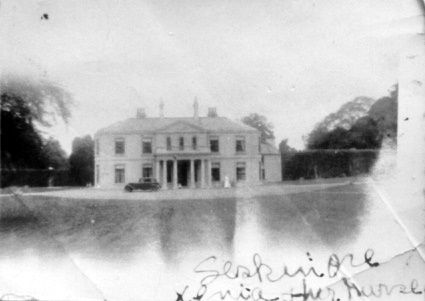
Dr. Mitchell was already aware of Xenia’s existence. Among his papers, he held a photograph of Seskinore House showing two indistinct figures standing in the foreground. Scribbled faintly across it were the words:
“Seskinore — Xenia & her nurse.”
The image had long intrigued him. For years, he had tried to discover what had become of the child in the photograph, making enquiries with various members of the McClintock family.
No one seemed to know.
As far as they were concerned, she had simply disappeared.
That sense of absence—of something missing from the story—stayed with me.
First Enquiries
After speaking with Dr. Mitchell, I began to feel that something was not quite right, particularly in the way Xenia’s inheritance and estate affairs had been handled.
When I asked her if she would allow me to make further enquiries on her behalf, she laughed and told me I was welcome to dig as much as I liked—but she doubted I would find anything of consequence.
Encouraged nonetheless, I contacted the Public Record Office of Northern Ireland (PRONI). Marion Molloy kindly confirmed that there were indeed extensive references to the McClintock family and the Seskinore estate.
Shortly afterwards, my mother and I travelled to Belfast, somewhat optimistically assuming that two days would be enough to review the records.
That illusion disappeared almost immediately.
PRONI and the Estate Records
Box after box of material was brought out.
What we found was extraordinary.
There were family scrapbooks filled with photographs and newspaper clippings—fragments of lives that brought Xenia’s ancestry vividly into focus.
More compelling still were the bundles of land registry deeds, outlining the extent of the Seskinore estate across generations.
At Marion’s suggestion, we continued our search at the Land Registry, tracing names connected to the estate:
- Xenia’s grandfather
- Her mother
- Her father
- Her trustee, Thomas Frederick Maddocks
It was here that the first real breakthrough occurred.
The 1952 Deed
We uncovered a deed registered in 1952 appointing new trustees to administer the estate.
Attached to it was a schedule of the real property still held in trust.
Further investigation revealed something unexpected:
While some properties had been sold, others appeared to remain—unaccounted for.
At that point, what had begun as family history became something else entirely.
An investigation.
The Missing File
Determined to trace what had happened, I contacted the law firm that had acted for the trustees.
At first, they denied any knowledge of the matter. They insisted that no files relating to Xenia or the Seskinore estate had survived.
It felt like a dead end.
But something about it did not sit right.
I persisted—calling repeatedly and eventually speaking to someone more senior. I explained that I already held a deed clearly showing their involvement.
The records had to exist.
Eventually, I received a call.
A file had been located:
“Xenia (Lewis) Joynson-Wreford — Seskinore Estate.”
Without hesitation, my mother and I booked a flight to London.
The Turning Point
Inside the file was what can only be described as the turning point.
There were:
- Original trust documents
- Property deeds
- Trustee records
- And a photograph of Xenia, taken on her twenty-first birthday

The missing pieces were beginning to fall into place.
Among the documents were deeds showing that property had been sold—even after Xenia came of age in 1956.
This was critical.
A Failure of Trust
The evidence suggested that the trustees had:
- Continued to manage the estate
- Failed to transfer ownership
- Failed to properly inform Xenia of her inheritance
When I raised this with the solicitors, they refused to assist, stating that any claim was now time-barred.
There would be no help from them.
Reconstructing the Estate
Undeterred, I continued.
My mother and I made several further trips to PRONI and the Land Registry, gradually building up a substantial archive of material:
- Deeds
- Maps
- Estate documents
Piece by piece, the estate began to re-emerge.
The more I uncovered, the clearer it became.
The trustees had failed in their duty.
Restoration
Using the documentary evidence—particularly maps and registered deeds—I was able to identify the remaining properties that should have passed to Xenia decades earlier.
With the guidance of my friend Caroline James, a solicitor specialising in Land Law, we carefully worked through the process.
By August 2007:
✔ Voluntary registration was completed
✔ Xenia’s name was formally placed on the titles
For the first time, her ownership was legally recognised.
Significance
What began as a simple question about a photograph became something far more significant.
The recovery of the Seskinore estate represents:
- The restoration of a broken inheritance
- The vindication of family memory
- The recovery of a story long fragmented by silence and loss
It ensured that part of the estate—and part of Xenia’s place within it—was not lost.