Overview
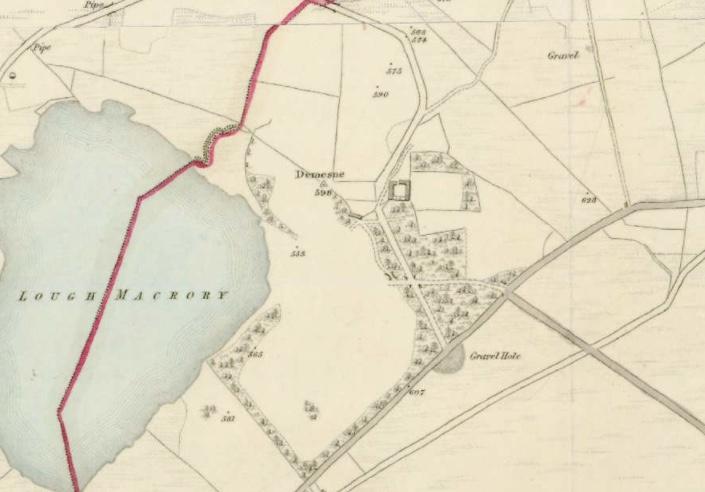
Following the decline of Ballygawley Park, the centre of the Stewart family’s life in County Tyrone shifted to Loughmacrory Lodge, near Carrickmore. From the later nineteenth century into the twentieth, it became the principal residence of the Stewart baronets and the setting for the family’s final phase as part of the Tyrone landed community.
It is also here that the Stewart family connects directly into the McClintock of Seskinore line, through the Peacocke marriage.
Early Association with Loughmacrory
The Stewart family’s connection with Loughmacrory dates from at least the early nineteenth century.
By 1837, it was recorded that:
“Loughmacrory” was the seat of Sir Hugh Stewart, Bart., of Ballygawley House and Loughmacrory Lodge.
— Lewis, Topographical Dictionary of Ireland (1837)
At this time, the family maintained multiple residences, with Ballygawley Park as the principal estate centre and Loughmacrory functioning as a secondary seat.
Transition from Ballygawley
During the later nineteenth century, the Stewart family’s residential focus gradually shifted.
Under:
Sir John Marcus Stewart, 3rd Baronet (1830–1905)
A detailed article published in the Fermanagh Herald on 16 January 1904, written by John Dorrian, provides valuable contemporary evidence for this transition.
Discussing the history of Ballygawley and the Stewart estate, Dorrian observed that:
“Sir John does not now reside at Ballygawley Park though there is a caretaker at the place, and his permanent residence is at Carrickmore Hall, once Termon-ma-Gurk.”
This statement is significant, as it demonstrates that by 1904:
- Ballygawley Park had effectively ceased to function as the principal family residence
- the house was maintained through a caretaker
- and the family’s main domestic focus had shifted to:
- Carrickmore Hall
- and later:
- Loughmacrory Lodge
The article also reflects broader changes affecting rural Tyrone during the late nineteenth century, including population decline, emigration, and the weakening of the traditional landed estate system.
Dorrian noted that Ballygawley, which had once approached a population of one thousand inhabitants, had by 1904 declined dramatically in size and importance.
His account traced the earlier history of the district from the Plantation period through the ownership of:
- Sir Gerald Lowther
- the Hamilton family
- the Beresford family
- and finally the Stewart family
before commenting upon the altered condition of the town and estate at the beginning of the twentieth century.
The 4th Baronet and the End of the Estate Era
Sir Hugh Houghton Stewart, 4th Baronet (1858–1942)
established Loughmacrory Lodge as the primary family residence.
Following:
- the sale of Ballygawley Park in 1918, and
- its destruction by fire in 1922
Loughmacrory became the effective centre of the Stewart family’s presence in Tyrone.
Sir Hugh, a Brigadier-General, JP, DL, and High Sheriff of County Tyrone (1903), resided at Loughmacrory Lodge for much of his later life. He died without issue in 1942.
The 5th and 6th Baronets
The title passed to his brother:
Sir George Powell Stewart, 5th Baronet (1861– ),
Lieutenant-Colonel, Royal Inniskilling Fusiliers.
He was succeeded by his son:
Sir Hugh Charlie Godfray Stewart, 6th Baronet (1897–1986)
who continued the association with Loughmacrory Lodge, which remained the principal family residence during his lifetime.
The Peacocke–McClintock Connection
The significance of Loughmacrory Lodge is closely tied to the marriage of the 6th Baronet.
In 1929, Sir Hugh Charlie Godfray Stewart married:
Rosemary Elinor Dorothy Peacocke
She was the daughter of:
- George Peacocke, and
- Elinor (“Nell”) Harriett Woodrop McClintock, of the McClintock of Seskinore family
Following her parents’ separation, Rosemary spent part of her early life at Seskinore House, reinforcing her connection to the McClintock family.
This marriage brought the Stewart family of Loughmacrory directly into the Seskinore network of families.
The marriage was later dissolved:
- Sir Hugh Stewart and Rosemary Peacocke were divorced in 1942
Later Generations
The 6th Baronet was succeeded by:
Sir David John Christopher Stewart, 7th Baronet (1935–2022)
By this stage, the traditional estate structure that had supported the family had largely disappeared, and Loughmacrory Lodge represents the later, reduced phase of landed family life in Tyrone.
Following his death, the succession passed to:
Sir Hugh Nicholas Stewart 8th Baronet (b. 1955)
Loughmacrory in Context
Loughmacrory Lodge stands in contrast to Ballygawley Park.
Where Ballygawley represents:
- expansion
- architectural ambition
- estate decline and destruction
Loughmacrory represents:
- continuity
- adaptation
- survival of family identity beyond the estate system
It illustrates how landed families adjusted to the changing economic and social realities of the late nineteenth and twentieth centuries.
Conclusion
Loughmacrory Lodge occupies a central place in the later history of the Stewart family of Athenree. As the focus of family life after the loss of Ballygawley Park, it represents the transition from the era of large landed estates to a more modest but continuous gentry presence.
Through the marriage of Rosemary Peacocke, it also forms a crucial link between the Stewarts and the McClintock of Seskinore, bringing the family fully into the network of Tyrone families explored on this site.
See Also
- The Stewart Family of Athenree, Ballygawley and Loughmacrory
- The Stewart Baronetcy of Athenree: Genealogical Register
- Ballygawley Park: Sale, Fire and Demolition
- The Peacocke–McClintock–Stewart Connection