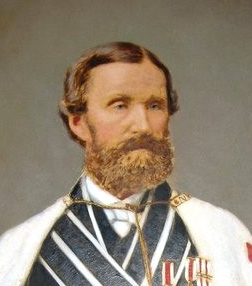
His death prompted an extraordinary outpouring of public grief, captured in a detailed obituary published in the Londonderry Sentinel.
The obituary makes clear that Charles Eccles was not simply respected—he inspired genuine affection across all levels of society.
It has never been our lot to discharge a more painful duty than to record the death of Charles Eccles, Esq., J. P., D.L., which took place at Ecclesville, on Thursday, the 4th inst., after a lengthened and distressing illness. The announcement some months ago, that he had become prostrated by disease, and that the medical gentlemen attending him entertained no hope of his recovery, was received throughout this county with the deepest regret, and although his was not a case in which the public could be said to have found any grounds for hoping against hope, the report of his death seemed in the end to carry with it the bitterness of a loss to which they had not yet been reconciled, while it produced in many breasts a sensation to which only the death of some actually beloved one can give rise.
We shall not say that Mr. Eccles was esteemed in this neighbourhood—he was more; the word which we have already used is a preferable one—he was beloved, beloved by his family, his friends, his tenantry, by every one who had an opportunity of knowing his worth. Upon the sorrowing circle at Ecclesville, we shall not, as it were in the presence of their dead, rudely enter to dilate upon the tenderness of home-relationships, rather would we simply offer them our respectful sympathy and condolence.
Outside that sacred bound however, we may more freely speak and to none of the excellencies in the character of this lamented gentleman would we give more prominence than the course which he invariably pursued in dealing with his tenants. He respected tenant-right and declared that he would regard himself as a robber were he to infringe upon it; the interest of the tenants in their beneficial improvements he looked upon as property the most sacred, and in the valuation of holdings upon his estate gave express directions not to value improvements, nor fix the rent at such a figure as would restrict the comforts of the tenant.
His income he considered ample for all his wants and he often generously observed that by increasing it he could add nothing to his own comfort while he abridged that of his tenants. Wherever the hand of death left a widow or helpless family upon the Ecclesville property, the rent was certain to be reduced for a longer or shorter period, so that the holding might not fall to a new occupant; and as in money so in political principle. Mr. Eccles was jealous of the independence of his tenantry and thought no greater evil could exist than the exercise of a landlord’s power to coerce the votes and public action of his people.
He would reason with his tenants and endeavour to show them that his interests and theirs were identical in matters affecting the public weal, but he would not injure or oppress those who differed from him; nevertheless few men were more willingly followed by their tenantry, for by his recognition of them as “independent electors” in the true meaning of the term, by his liberal management of his property, respecting tenant-right, giving leases to every tenant of good character and industry, and always charging moderate rents, he won not only their votes but their hearts; in short the regard in which he was held was almost idolatrous, and partook more of an uncalculating feudal attachment than of the staid, measured feelings of modern times.
Mr. Eccles’ manner was peculiarly genial and winning, and though retiring and unobtrusive, few had greater influence over those with whom they came in contact; he had a profound knowledge of men and things, his opinions were matured, carefully reasoned out and settled, no one saw better the difficulties of a position, or was more fertile in expedients to remove or nullify them. Those who knew him intimately gladly resorted to him for advice and direction, and his sound sense, thorough knowledge of life, and unblemished honour, made him a safe and trusted guide.
Of Mr. Eccles as a public man our readers had many opportunities of judging. As a Magistrate, Grand Juror, Governor of the District Asylum, Member of the Board of Superintendence, &c., he was well known in the county, and known everywhere to be admired and respected. Nay it is a remarkable fact that slander which is so generally equipped for an attack either upon the living or dead, does not appear to have even one of its unhallowed shafts to level at his memory. We have heard his character discussed by men of high as well as men of humble standing, by Liberals and Conservatives; we have heard it discussed in the motley crowd, and we gathered from every source the same estimate, found him everywhere described as one of the few men who could be named in the cause of human excellence.
But better than all, he turned his thoughts to something still higher and nobler. Not content with mere morality, not content with occupying a high place in the estimation and in the affections of those around him, not content with having within his reach an ample share of the best pleasures of this life, he sought for an earnest of the pleasures of the life to come; he grounded his faith upon the Rock of Ages, and, when his earthly pleasures failed:
“He sent his hopes on high, looked up and reached
His sickle forth, and reaped the fields of heaven,
And plucked the clusters from the vines of God,”
The Eccles family settled in Fintona during the reign of Charles II., and are amongst the oldest and most influential of the county families. They derived their surname from the Barony of Eccles in Dumfriesshire which they held in Scotland. Eighth in descent from John de Eccles, a person of rank in the reign of Alexander the 3rd, was John Eccles of Kildonan in Ayrshire who lived in the early part of the 17th century and had two sons, John and Gilbert; the eldest was a distinguished royalist, Gilbert settled in Ireland in the reign of Charles I., and purchased several manors in Tyrone and Fermanagh. He died, as appears from his cenotaph in the old church of Fintona, July 26, 1694, at the advanced age of 92, and was succeeded in the Tyrone property by his eldest son Charles Eccles, who was High Sheriff of Tyrone in 1694 and was great-great-great-grandfather of the gentleman just deceased.
The late Mr. Eccles was born 9th April 1813 and married Isabella, daughter of Edward Blake, Esq., of Castlegrove, County Galway, who died in 1859. He served as High Sheriff of Tyrone in 1835 and was a Magistrate and Deputy-Lieutenant of the County. He was on several occasions requested to stand for the representation of Tyrone but persistently declined the honour. He received the first requisition on this subject shortly after he had attained his majority and had then an offer of support from all the leading gentry of the county; subsequently he was urged by a very influential nobleman to allow himself to be put in nomination, and again and again a similar proposition emanated from different sources, but he preferred having the honour conferred on others to seeking it himself.
Had he been induced to come forward there could be as little doubt as to his success as there would have been to his ability to stand upon the floor of the House and, with polished eloquence and enlightened judgment, address himself to any question of the day.
Mr. Eccles is succeeded by his eldest son, John Stuart Eccles, Esq., who about twelve months ago attained his majority.
On Monday last, the day fixed for consigning the mortal remains of the deceased to their resting place, a vast concourse assembled at Ecclesville to embrace their last opportunity of publicly manifesting their respect for his memory. Carriages arrived every few moments, and the trains from Derry and Enniskillen brought large numbers from the towns along the line. Omagh contributed its quota to the melancholy gathering, and though so many miles distant from Ecclesville nearly all the principal shopkeepers partially closed their places of business, while the peals of the Omagh Church bell further reminded the inhabitants that death had been executing its fatal mission in their county.
At the hour fixed the mournful procession left Ecclesville in the following order:—
Pall Bearers
Col. The Hon. Stuart Knox, M.P.
Capt. Ynyr H. Burges
Wm. Archdall, Esq., D.L.
J. G. Vesey Porter
Capt. George Perry M’Clintock, D.L.
Major A. W. Cole Hamilton, D.L.
Thomas H. Browne, Esq., D.L.
Samuel Vesey, Esq., D.L.
Capt. Mervyn Stewart
Capt. Thomas Auchinleck, J.P.
Chief Mourners
John S. Eccles, Esq.
Rev. Robert G. Eccles
Dr. Henry Thompson
Charles B. Eccles, Esq.
Sir Richard McCausland
Rev. Mungo Thompson
The tenants of the Ecclesville Estate, all wearing scarfs and hat bands.
The Ecclesville labourers with hat bands.
The remainder of the procession was made up of men of every class and creed, appearing for the moment to anticipate the time when they themselves would have “shuffled off this mortal coil” and entered side by side into that common inheritance to which they were all hastening.
Amongst those present were—The Very Rev. the Dean of Clonfert; Very Rev. the Dean of Clogher; Rev. R. V. Dixon, D.D.; Rev. W. S. Burnside, D.D.; Rev. John Grey Porter; Rev. Samuel Alexander; Rev. T. L. Stack; Rev. H. L. St. George; Rev. Henry Tottenham; Rev. W. Moutray; Rev. Charles H. Stack; Rev. Charles Maguinness; Rev. J. C. Hudson; Rev. John Flanagan; Rev. George Sidney Smith, jun.; Rev. Charles F. Jones; Rev. J. Whittaker; Rev. J. Rowland Scott; Rev. P. Kerr; Rev. J. M’Groarty; Rev. J. Thornhill; Rev. R. Chambers; Rev. John Arnold; Rev. John Smyth; Rev. William Mulloy; Rev. J. McArdle; Rev. J. Cassidy;
Colonel Dawson; Major Francis Ellis; Captain Butler; Captain Corr; Captain R. C. D. Ellis; Captain Knox; Captain Sinclair; Captain J. J. O’F. Carmichael Ferrall; Captain Vesey; Captain L. M. Buchanan; Captain Jenkins; Captain R. S. Hamilton;
George A. Molony, Esq., R.M.; W. Cole Hamilton, Esq., B.M.; A. W. H. Heard, Esq., D.L.; Nicholas M. Archdall, Esq., D.L.; George Scott Mansfield, Esq., J.P.; James Crossle, Esq., J.P.; Edward Waller, Esq., J.P.; A. C. Buchanan, Esq., J.P.; George Hall Stack, Esq., J.P.; J. W. Ellison Macartney, Esq., High Sheriff of Armagh; Wm. F. Black, Esq., J.P.; James Greer, jun., Esq.; Edward Atthill, Esq., J.P.; A. O. S. M. McCausland, Esq.; James Mackay, Esq.; George A. Rogers, Esq.; Millar Simpson, Esq.; William Caldwell, Esq.; Mansergh G. Buchanan, Esq.; James Campbell, Esq., S.I.; George Vesey Stewart; Richard Tottenham, Esq., J.P.;
Dr. Robinson, J.P.; Dr. West; Dr. Wilson; Dr. Love; Dr. Buchanan; Dr. Trenar; Quarter-master John Core; Robert Buchanan, Esq.; John Dickson, Esq.; George Woodhouse, Esq.; James Johnston, Esq.; John Dickson, jun., Esq.; Hugh Allen, Esq.; M. Moore, Esq.; Cecil Moore, Esq.; T. C. Dickie, Esq.; Whitney Moutray, Esq., J.P.; Henry Moutray, Esq., J.P.; Finlay Buchanan, Esq.; Charles Richardson, &c., &c.
Only a small portion of those present could gain admittance to the church, and through the anxiety to follow the coffin the doors were literally blocked up by those who were fortunate enough to be near the front of the procession.
The first portion of the burial service was read by the Rev. H. Tottenham, assisted by the Rev. John McGroarty, and before leaving the church the Rev. Dr. Burnside delivered a short but impressive address. He enumerated the payment of a tribute of respect for the departed, the comfort which it brought to the mourners, and the instruction which it was calculated to convey to them and to their sympathising friends.
He alluded in feeling terms to the many claims which the deceased gentleman had upon the respect of all who knew him, to his amiability in every relation of life, and to the bright example which was to be found in his career, whether as a devoted husband, an affectionate father, or an indulgent landlord, and made touching reference to his conversion and deeply rooted piety, whereby his affections had been most fully weaned off the things of earth, and through which he was enabled to look upon his approaching dissolution, not as the dreaded appearance of the King of Terrors, but as the appointed and glorious means of opening to him the gates of everlasting bliss.
Dr. Burnside, in conclusion, called the attention of his hearers to the prayer of the Psalmist, “So teach us to number our days that we may apply our hearts unto wisdom,” and expressed an earnest hope that divinely taught and guided they might, at the final hour, be enabled to say with the deceased, “O grave where is thy victory, O death where is thy sting?”
An appropriate hymn was sung by the choir while the coffin was being removed, and the funeral procession having re-formed, the remains were borne to the ancient burying ground of Donacavey where the coffin was laid in the family vault, and all that remained of this highly gifted and noble man was, with the deep impressiveness of the concluding portion of the burial service, committed to its kindred earth, in sure and certain hope of a glorious resurrection.
The closing sections of the obituary move from public life to spiritual reflection, portraying a man whose identity extended beyond estate and status.
All united in a shared moment of remembrance.
This obituary is presented in full and in its original form. Paragraph spacing and section headings have been added for readability; the text itself remains unaltered.