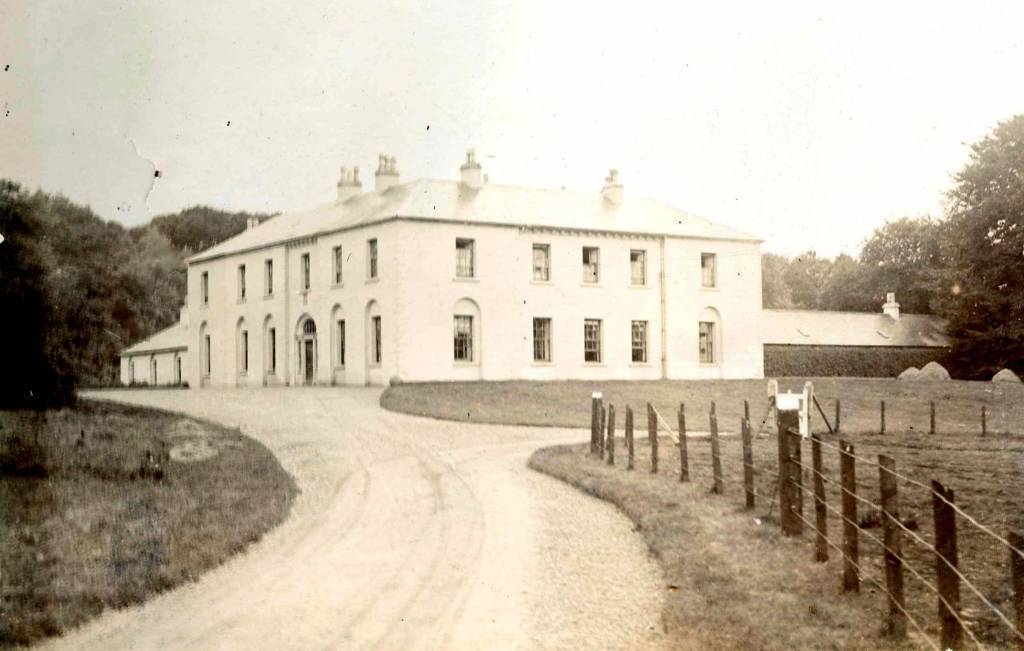
Dispersal of a Country House Collection
Introduction
Following the death of Raymond Saville Conolly de Montmorency Lecky Browne-Lecky in November 1961, the contents of Ecclesville House, County Tyrone, were dispersed in a public auction held in early 1962.
The sale marked the end of Ecclesville as a fully furnished country house and resulted in the widespread dispersal of its paintings, furniture, personal possessions, and family heirlooms.
The Auction Sale (February 1962)
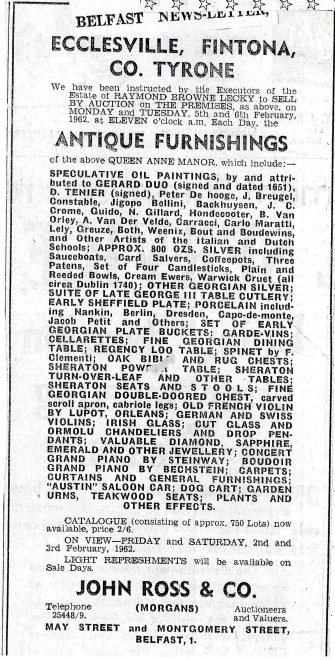
The contents of Ecclesville were sold over two days, 2nd and 3rd February 1962, attracting considerable attention.
Buyers attended from:
- Northern Ireland
- Dublin
- London
- continental Europe
- and the United States
The total realised was in excess of £23,000, a substantial sum at the time and regarded as a record sale locally.
A House of Remarkable Contents
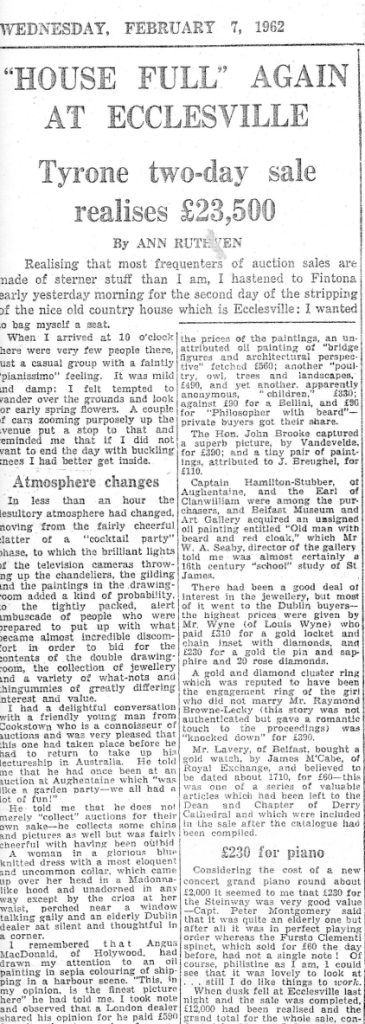
Reports of the sale described Ecclesville as a house rich in artistic and historic objects.
The collection included:
- oil paintings attributed to European masters
- Georgian and earlier furniture
- silver and decorative objects
- musical instruments
- personal effects and curiosities
Among the paintings noted were works attributed to:
- Gerard Dou
- Constable
- Teniers
- Breughel
Although attributions in such sales must be treated with caution, the collection was clearly of considerable quality and variety.
Highlights from the Sale
Among the items attracting particular attention were:
- a Queen Anne Irish silver tankard
- Georgian mahogany furniture
- silver candlesticks and tableware
- jewellery pieces acquired by Dublin dealers
- a violin by N. Lupot (c.1780), sold for £460
- a Steinway concert grand piano
- Raymond’s 1937 Austin saloon motor car
The sale also included numerous paintings of varying sizes and subjects, many of which were purchased by dealers and dispersed into private collections.
The Portrait Collection
A significant portion of the contents consisted of family portraits associated with the Eccles, Browne, and related families.
In his will, Raymond Browne-Lecky directed that these portraits should be transferred to the Dean and Chapter of Londonderry Cathedral.
However, rather than being retained as a collection, the portraits were sold in 1962 on professional advice.
The Cathedral received £778 15s 0d from the sale.
Crucially, the portraits were not included in the printed auction catalogue, which had already gone to press. As a result:
👉 no definitive record survives of which portraits were sold or where they went
Contemporary Newspaper Report
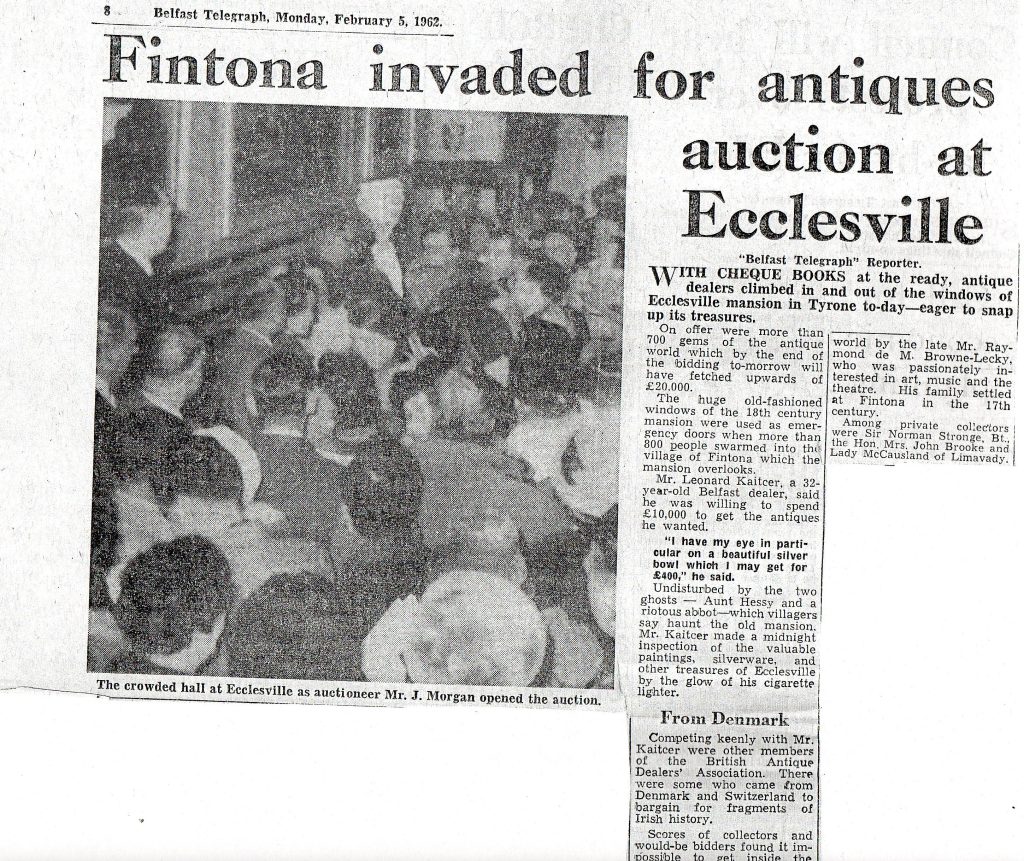
A contemporary report described the sale in vivid terms:
“The auction revealed that Ecclesville was a veritable Aladdin’s cave…”
“Buyers [came] from as far apart as the United States, the Continent, London, Dublin and Belfast…”
“So great were the crowds… that many people found great difficulty in getting into the house… several ladies… clambered through the windows.”
The report confirms both the scale of the sale and the exceptional public interest it attracted.
Selected Highlights from the Sale
Among the recorded prices:
- £560 – oil painting (“Bridge, figures and architectural perspective”)
- £490 – “Poultry, owl, bees and landscape”
- £390 – painting by Van de Velde
- £460 – Queen Anne Irish silver tankard
- £460 – Lupot violin (c.1780)
- £410 – pair of Dublin silver candlesticks
- £510 – Georgian mahogany plate stands
- £230 – Steinway grand piano
- £40 – 1937 Austin saloon car
The McClintock Portrait
One portrait was specifically excluded from the general bequest.
This was the portrait of Mrs. Amy Henrietta McClintock (née Eccles), which Raymond left to her granddaughter, Xenia Joynson Wreford.
Despite this clear instruction, the fate of the painting is uncertain.
At the time of a visit recorded in the Belfast Telegraph, the portrait was still hanging in the music room at Ecclesville, suggesting that the bequest had not been carried out.
Later recollections indicate that it may have been removed prior to the sale, while other evidence suggests it had previously been housed at Seskinore.
An insurance inventory of 1914 describes:
“Oil painting: Portrait of Mrs. A. H. McClintock… by Costa… in heavy Florentine frame…”
The artist is likely to have been John da Costa.
The present whereabouts of the portrait remain unknown.
A House Dispersed
The auction of 1962 transformed Ecclesville from a furnished historic house into an empty structure.
Its contents were:
- dispersed across multiple countries
- absorbed into private collections
- partially lost to record
Even where sale prices are known, provenance was often not preserved, making later identification difficult.
Significance
The dispersal of the Ecclesville contents reflects a wider pattern seen across Ireland and Britain in the mid-twentieth century.
Large country houses, no longer economically sustainable, were:
- sold
- stripped of contents
- and frequently demolished
In many cases, as at Ecclesville:
- collections were broken up
- documentation was incomplete
- and important historical associations were lost
Legacy of the Sale
Although the sale realised a substantial sum, its long-term consequence was the irreversible loss of Ecclesville as a coherent historic interior.
The house itself survived for a number of years after the auction, but without its contents, it had lost much of its character and significance.
The events of February 1962 therefore represent not only a sale, but the effective end of Ecclesville as a living historic house.
See Also
- Will and Bequest of Raymond Browne-Lecky (1961)
- Final Attempts to Save Ecclesville (1961–1962)
- Later Life at Ecclesville & Final Years (1920–1961)
- Ecclesville House: Later History and Demolition (1962–1978)
- Ecclesville Auction Catalogue (1962)
- Ecclesville House, Fintona, County Tyrone