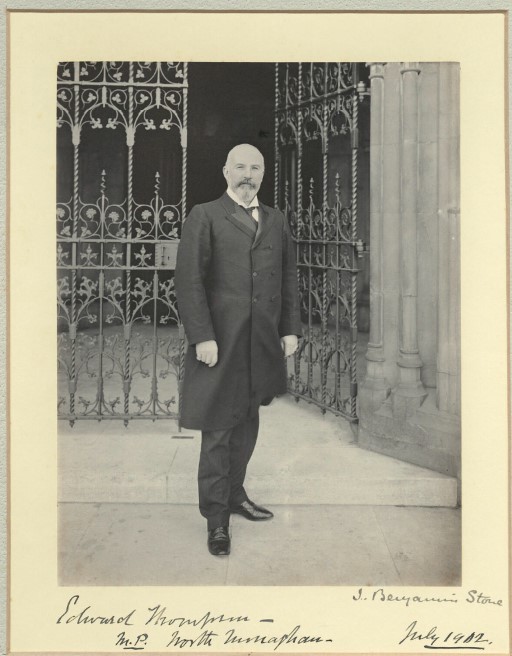
© National Portrait Gallery, London
Guardian of the Eccles Heirs and a Key Link Between the Eccles and McClintock Families
Introduction
Dr Edward Charles Thompson, M.B., F.R.C.S.I., D.L., of Omagh, County Tyrone, was one of the most prominent medical and public figures in late nineteenth- and early twentieth-century Ulster.
A distinguished surgeon, administrator, politician, and military medical officer, he also played a central role in the affairs of the Ecclesville estate after the death of John Stewart (or Stuart) Eccles in 1886. Through family relationship, legal responsibility, and marriage, Thompson became an important connecting figure between the Eccles, McClintock, Blake, and related Tyrone families.
Family Background
Edward Charles Thompson was born in 1852, the son of Dr Henry Thompson, M.D., of Omagh, and Anne Henrietta Blake, daughter of Edward Blake of Castle Grove, County Galway.
Through his mother, he belonged to the Blake family of Castle Grove, one of the principal landed families of County Galway. This connection linked him closely to the Eccles family, since Isabella Blake, grandmother of Amy Eccles, was sister to his mother Anne Henrietta Blake.
He was therefore first cousin once removed to Amy Eccles and her sisters.
The same Blake lineage also connected with the Knox family of Castlerea, County Mayo, a line that likewise appears in the ancestry of the McClintock family. These overlapping relationships illustrate the closely interwoven nature of the Irish landed and professional classes.
Education and Early Career
Thompson was educated at Trinity College, Dublin, where he qualified in medicine. He briefly served in the Royal Navy before returning to Omagh to pursue his professional career.
From an early stage he was associated with both public service and local county life, combining medical work with wider social and administrative influence.
Military Associations
During the 1870s, Thompson served as:
- Assistant Surgeon, Royal Tyrone Fusiliers
In this capacity he served alongside:
- Major George Perry McClintock
- members of the Ellis family
- his brother, Lieutenant John Blake Thompson
These military and social connections placed him within the same circle as the McClintock family long before any formal marriage alliance emerged.
First Marriage: The Ellis Family
In July 1877, Thompson married Diana Ellis, youngest daughter of Colonel Francis Ellis of Seaton Lodge, at St Columba’s Church, Omagh.
The marriage was widely reported and clearly regarded as an important local social occasion.
They had two children:
- Edith Louisa Thompson
- Frank Thompson
Diana died in 1887.
Medical Career and Public Life
In 1875, Thompson succeeded his father as surgeon to the Tyrone County Hospital, beginning a career that lasted more than fifty years.
He played a major part in:
- the development of hospital services in County Tyrone
- the planning and establishment of the new Tyrone County Hospital, opened in 1899
- the production of detailed annual medical and administrative reports
He was not merely a practising surgeon, but also an energetic organiser and administrator. Contemporary accounts describe him as a man of exceptional drive, presence, and ability. His and his father’s combined service amounted to almost a century of medical care in the county.
The Albert Medal
In 1885, Thompson was awarded the Albert Medal (Second Class) for conspicuous bravery in attempting to save the life of a child suffering from diphtheria.
This honour reflected both his professional courage and the high public regard in which he was held.
Political Career
Thompson also entered public life as a politician and served as:
- Member of Parliament for North Monaghan (1900–1906)
Although a Protestant, he sat as a Nationalist MP, a notable and somewhat unusual position that reflects both his independence and his broad standing in Irish public life.
Second Marriage: The McClintock Connection
On 23 October 1890, Thompson married Dorothea Selina (“Dodo”) McClintock at Seskinore Chapel of Ease.
She was the daughter of:
- Colonel George Perry McClintock of Seskinore
and the sister of:
- Colonel John Knox McClintock
This marriage made Thompson brother-in-law to John Knox McClintock, creating a direct family link between the Thompson and McClintock households.
Guardian of the Eccles Children
Following the death of John Stuart Eccles in 1886, and of his widow in 1887, Thompson was appointed:
- executor
- guardian
to the Eccles daughters:
- Amy Henrietta Frances Eccles
- Rose Isabel Eccles
- Anna Theodosia (“Dosie”) Eccles
His appointment reflected both his professional standing and his close blood relationship through the Blake family.
He thus stood at the centre of the legal and family arrangements governing the Ecclesville estate during the minority of the Eccles children.
The Eccles–McClintock Connection
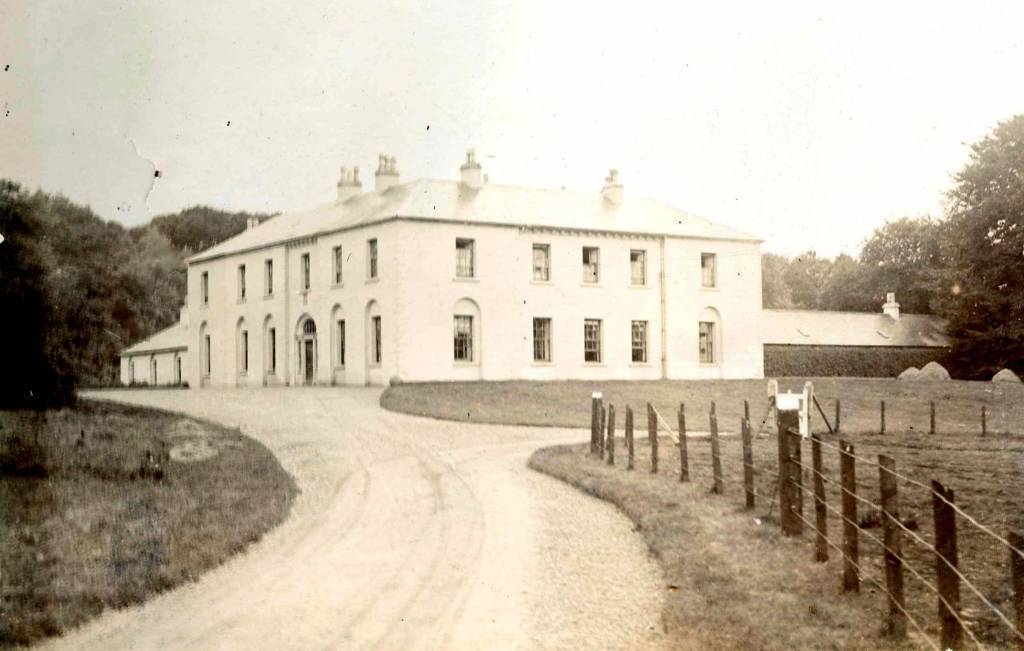
Thompson occupied a uniquely important position in the later history of Ecclesville because he linked several family networks at once.
He was:
- a Blake relative of the Eccles daughters
- the legal guardian of Amy, Rose, and Dosie
- a former military associate of the McClintock circle
- the brother-in-law of John Knox McClintock
Given these connections, it is highly likely that he played an influential role in the marriage of Amy Eccles to John Knox McClintock in 1893. By that date, he was already closely involved in the affairs of both families.
The 1893 Marriage Settlement
A particularly important document survives in the form of the marriage settlement indenture dated 26 April 1893, made shortly before the marriage of John Knox McClintock and Amy Henrietta Eccles.
This document records Thompson as a named party to the settlement, alongside members of the McClintock and Alexander families.
Its significance is considerable. It confirms that:
- Amy Eccles was a ward of the Court of Chancery in Ireland
- the marriage required formal legal approval
- her property and financial interests were being formally settled and protected
- Edward Charles Thompson was actively involved in the legal arrangements governing the union
This shows that his role extended beyond guardianship into direct participation in the legal structuring of the marriage and estate settlement.
The following indenture, dated 26 April 1893, forms part of the marriage settlement agreed immediately prior to the marriage of John Knox McClintock and Amy Henrietta Eccles.
It records Dr Edward Charles Thompson as a named party to the settlement and confirms his active role in the legal arrangements governing the marriage and the protection of Amy Eccles’s property.

Showing Dr Edward Charles Thompson as a party to the settlement between John Knox McClintock and Amy Henrietta Eccles. The document confirms that Amy was a ward of the Court of Chancery and that the marriage required formal legal approval under the Infant Settlements Act (1855).
Why the Marriage Settlement Matters
The 1893 settlement is one of the clearest pieces of evidence for Thompson’s importance.
It demonstrates that the marriage of Amy Eccles and John Knox McClintock was not merely a social alliance, but also a carefully supervised legal and estate arrangement. Thompson’s presence in the deed places him at the heart of that process.
In practical terms, he was involved in the transition from:
- the Eccles inheritance problem
- to the McClintock–Eccles marriage alliance
This makes him one of the key figures in the late history of the Ecclesville estate.
Later Life and Third Marriage
Thompson later married Mary Clarke.
He continued his medical and public activities well into the early twentieth century, including wartime service and further professional work after the opening of the new hospital.
He remained a figure of unusual influence in County Tyrone, remembered both for his administrative energy and for his striking personal character.
Character and Reputation
Contemporary descriptions present Thompson as:
- energetic
- capable
- commanding
- generous
- socially influential
He was widely regarded as one of the most distinguished men in County Tyrone public life, combining professional authority with a remarkable degree of local influence.
Death and Burial
Dr Edward Charles Thompson died on 20 January 1935.
He was buried at Clanabogan Churchyard, County Tyrone.
His death was widely mourned, and he was remembered as one of the most significant medical and civic figures of his generation in Tyrone.
Historical Significance
Dr Edward Charles Thompson is significant not only for his medical and political career, but for his place within the intertwined history of the Ecclesville and Seskinore estates.
He stands at the intersection of:
- the Blake connection to the Eccles heirs
- the guardianship of the Eccles children after 1886
- the legal administration of the Ecclesville estate
- the marriage alliance between Amy Eccles and John Knox McClintock
He was, in effect, a key intermediary in the transition from the later Eccles line to the McClintock connection.
See Also
- John Stuart Eccles and the Ecclesville Entail
- Amy Henrietta Frances Eccles McClintock
- John Knox McClintock & Amy Eccles
- The McClintock Family of Seskinore
- The Eccles Family of Ecclesville
- Will of John Stuart Eccles (1873)