Leila McClintock: The Final Generation
Introduction
Amelia (“Leila”) Isobel Eccles McClintock (1898–1937) was the only child of Colonel John Knox McClintock of Seskinore and Amy Henrietta Frances Eccles of Ecclesville.
As sole heir to Seskinore, she represented the final direct generation of the McClintock family to reside at the estate.
Her life stood at the meeting point of inheritance, expectation, war, loss, and transition. Though brief, it became deeply bound up with the final chapter of Seskinore House and the emotional history of the estate itself.
Early Life and Inheritance
Leila McClintock was born into one of the most established landed families in County Tyrone.
From birth, her life was shaped by inheritance, continuity, and expectation. She represented not simply a daughter, but the future of the Seskinore estate itself.
Her upbringing moved between Ecclesville and Seskinore, reflecting both her mother’s inheritance and the evolving realities of estate life.
During her early years, Ecclesville remained an important centre of family life following the marriage of her parents in 1893.
There was every expectation that Leila would eventually marry and produce an heir who would continue the family line and maintain the continuity of the Seskinore estate.
That expectation — deeply embedded in the legal and social structure of landed society — would ultimately shape the tragic course of the family’s later history.
Birth at Harcourt Street, Dublin
Leila McClintock was born at:
81 Harcourt Street, Dublin
on 21 July 1898.
Her civil birth certificate records her as:
Amelia Isobel McClintock
daughter of:
- Captain John Knox McClintock, Royal Inniskilling Fusiliers
- and Amy Henrietta Frances McClintock, formerly Eccles.
Although born in Dublin, Leila’s childhood was closely associated with both Ecclesville and Seskinore, where the family spent much of their time during her early years.

The Harcourt Street address reflects the family’s connections with Dublin society during the late Victorian period, while the continuing importance of Ecclesville is demonstrated by contemporary records showing that Amy and John Knox McClintock still maintained close ties to the estate during the 1890s.
Birth certificate of Amelia (“Leila”) Isobel McClintock, born at 81 Harcourt Street, Dublin, 21 July 1898.
Life Between Ecclesville and Seskinore
In the early years of their marriage, John Knox McClintock and Amy Eccles initially resided at Ecclesville rather than immediately establishing permanent residence at Seskinore.
A major celebration held at Ecclesville on 1 May 1895, marking Amy McClintock’s coming of age, confirms the estate’s importance during this period.
Rejoicings at Ecclesville – Coming of Age of Mrs. M’Clintock
(Tyrone Free Press, 4 May 1895 – Extract)
“On Wednesday the beautiful grounds surrounding Ecclesville were the scene of much animation on the occasion of the celebration of the coming of age of the popular owner… upwards of 400 invitations had been issued… all the public rooms of the house… were utilised… the guests were enabled to dine in comfort…”
“Captain M’Clintock took the chair… accompanied by Mrs. M’Clintock and members of the family…”
Transition to Seskinore
Sometime between 1898 and 1901, the family relocated to Seskinore, where they are recorded in the 1901 census.
The delay in moving may be explained by:
- ongoing rebuilding works at Seskinore House
- and the inheritance realities surrounding Ecclesville.
Photographs dated 1903 show substantial alterations to Seskinore House, particularly to the side and rear facing the walled garden. These included enlargements and architectural modifications designed to harmonise with the existing structure.
At the same time, it had become increasingly apparent that, in the absence of a surviving male heir, the Ecclesville estate would ultimately pass outside the McClintock line under the terms of entail.
This likely strengthened the decision to establish Seskinore as the principal family seat.
Childhood at Seskinore
Leila spent her childhood at Seskinore, growing up within the rhythms of estate life.
Although little survives in the written record, photographs and family recollections offer glimpses into her character and attachment to the estate.
One story long remembered within the family recounts how, as a child, Leila created a small garden near the house and placed at its entrance a sign reading:
“Please Knock.”
The story became deeply significant after her death, as the garden itself would later become her final resting place.
War Service: Women’s Royal Air Force
During the First World War, Leila served in the Women’s Royal Air Force (WRAF), reflecting the wider wartime contribution of women during the conflict.
She enrolled on 27 November 1917 at:
21st Wing, Rendcomb
and served as a:
Motor Transport Driver (Crossley vehicles)

AD 4757
Her official service record described her work as:
“highly satisfactory and thoroughly exemplary”
while her character was recorded simply as:
“Excellent.”
Women’s Royal Air Force
Certificate of Discharge on Demobilization
- No.: 2465
- Name: McClintock, Leila
- Rank: Member
- Trade: M.T. Driver (Crossley)
- Enrolled: 27 November 1917
- Station: 21st Wing, Rendcomb
Description
- Age: 20
- Height: 5 ft 9 in
- Build: Slight
- Eyes: Grey
- Hair: Fair
Marriage and Early Adulthood
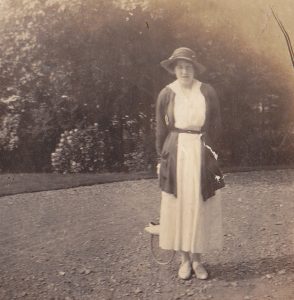
In 1920, Leila married:
Lieutenant Cecil Rhodes Field
The marriage was short-lived and ended in divorce in 1927.
She later married:
Captain Wilfred (“Tony”) Heyman Joynson-Wreford
a former RAF officer with a strong interest in aviation.
They married in 1932 and had one daughter:
Penelope (“Xenia”) Joynson-Wreford
(b. 3 August 1935)
Return to Seskinore
By the mid-1930s, plans were underway for Leila and Tony to return permanently to Seskinore, likely to assist in managing the estate following the advancing age of Colonel John Knox McClintock.
Following the Colonel’s death in October 1936, Leila and Tony returned to Seskinore with their young daughter, Xenia.
For a brief moment, it appeared that the estate might enter a renewed phase of family occupation and continuity.
The Final McClintock Inheritance
Following the death of Colonel John Knox McClintock in October 1936, Leila became the final direct representative of the McClintock line at Seskinore.
For a short period, it seemed possible that the estate might continue under Leila and Tony Joynson-Wreford.
Their return to the house with their daughter appeared to offer a renewed future after years of uncertainty surrounding the estate.
Leila therefore stood at a unique point in the history of Seskinore:
- the last McClintock heir to reside at the house
- the link between the Perry, McClintock, Eccles, and Joynson-Wreford families
- and the final generation for whom Seskinore remained a lived family home.
However, her inheritance was tragically brief.
Only around three months later, Leila died from meningitis on 30 January 1937.
Her sudden death abruptly ended the direct succession of the McClintock line at Seskinore and created a major turning point in the history of the estate.
Under her will, dated 22 January 1935, she appointed her husband, Captain Wilfred Heyman (“Tony”) Joynson-Wreford, sole executor and left to him:
“all my real and personal estate whatsoever and wheresoever … absolutely”
Settlement and Conveyance papers executed during 1937–1938 subsequently transferred the remaining estate lands, mansion house, investments, and trust funds to Tony, completing the final transition of Seskinore from the McClintock family into the Joynson-Wreford line.
Leila’s death also had profound personal consequences. Her daughter Xenia was still a young child, and Tony himself appears never to have recovered emotionally from the loss. Family recollections later described his daily visits to Leila’s grave in the Garden of Remembrance at Seskinore during the years before his own death in 1940.
Although ownership later passed through the Joynson-Wreford family, the continuity represented by Leila herself was broken.
The years that followed would witness the gradual decline, sale, and eventual demolition of Seskinore House.
Contemporary Newspaper Account
Tyrone Constitution
5 February 1937
The scale of the shock felt across Seskinore and the surrounding district was captured in the contemporary newspaper account published shortly after her death.
The article described the grief felt throughout Seskinore, Fintona, and Omagh, emphasising that Leila and Tony had only recently returned to establish a permanent future at the estate.
Particular attention was given to:
- the affection felt for Leila locally
- the symbolic importance of her return
- and the widespread mourning that followed her death.
The report concluded with the moving description of her burial within the small garden she had created as a child.
The Garden of Remembrance
Following her death, Leila was buried not within the formal McClintock burial ground, but within the small garden she had created as a child near Seskinore House.
At her burial, Rev. R. Dougherty spoke the now-famous words:
“As a little girl, she made a garden on this site. With her own little hands she planted flowers here…”
“That spot, made sacred by her associations with it when she was a child is now to be sanctified by her abiding presence.”
The garden thereafter became:
The Garden of Remembrance
forming one of the most emotionally significant locations associated with Seskinore.

Grief and Decline: The Aftermath of Leila’s Death
Following Leila’s death, the atmosphere at Seskinore changed profoundly.
Each evening at six o’clock, Tony Joynson-Wreford reportedly walked Leila’s dog to the Garden of Remembrance, where he would sit beside her grave for long periods.
Estate staff later recalled that he never truly recovered from her death.
Over the following years, Tony’s health deteriorated steadily.
By 1939, he had been diagnosed with tuberculosis and was transferred to Switzerland for treatment at:
Kurhaus, Clavadel, near Davos
accompanied by Xenia and nursing staff.
Tony died there on:
23 March 1940
Tony Joynson-Wreford’s Final Wishes
In his will, Tony left deeply personal instructions concerning Seskinore and Leila’s grave:
“IT IS MY WISH that should my Trustees sell or let Seskinore House they should reserve to all members of my family or of the family of McClintock… the right in perpetuity to enter the said grounds for the purpose of visiting the grave of my said Wife and to keep-up the Garden of Remembrance wherein she is buried.”
He further requested that his ashes be scattered within the garden beside Leila.
Following the war, his ashes were interred beside her grave at Seskinore.
Legacy
Leila’s life was brief, but her significance within the history of Seskinore is profound.
She stood at a moment of transition:
- the final direct McClintock heir at Seskinore
- the bridge between the old landed world and its final phase
- and the figure around whom memory, grief, and legacy would ultimately gather.
Her death marked not merely a personal tragedy, but the beginning of the end of Seskinore as a lived family home.
What survived thereafter was memory — preserved in:
- the Garden of Remembrance
- the surviving estate landscape
- archival records
- and the later rediscovery of the estate through her daughter, Xenia.
Through Xenia Joynson-Wreford, Leila’s story did not end, but instead entered a new and unexpected chapter.
Continue Reading
- Amy Henrietta Frances Eccles (1874–1942)
- Penelope (“Xenia”) Joynson-Wreford
- Xenia Joynson-Wreford: Early Life, Loss and Rediscovery
- The Chapel of Ease at Seskinore (Consecrated 1873)
- Tony Joynson-Wreford’s Will and the Sale of Seskinore
- The Decline and End of the Seskinore Estate (1940s–1952)
- The Garden of Remembrance at Seskinore
- John (“Jack”) Knox McClintock & Amy Henrietta Frances Eccles