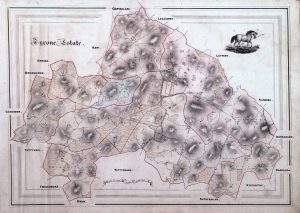
Ecclesville, Fintona, and the Human Face of a Tyrone Estate
Introduction
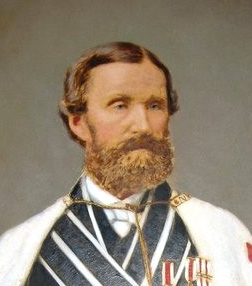
In the long history of the Eccles family of Ecclesville, few figures stand out as clearly—or as warmly remembered—as Charles Eccles (1813–1869).
A landlord in an age often defined by tension and inequality, he belonged to a generation whose authority rested not only on land, but on relationship. Contemporary accounts suggest that he was not merely respected, but genuinely beloved—a distinction rarely granted in the Ireland of the 19th century.
His life offers a rare and revealing glimpse into a different model of estate society: one built on mutual obligation, local presence, and a deeply personal connection between landlord and tenant.
Inheritance and Responsibility
Born on 9 April 1813, Charles Eccles came of age at a pivotal moment in the history of the estate.
He inherited not only land, but expectation.
The Ecclesville estate, long established in Fintona, required careful management—its prosperity dependent on agriculture, tenancy, and local stability. From an early stage, Charles appears to have understood that his role extended beyond ownership. He was, in effect, the central figure in a small but complex rural world.
In 1835, he served as High Sheriff of County Tyrone, affirming his position within both local and regional society.
The 1834 Dinner: A Defining Moment
The character of Charles Eccles is perhaps best captured in a remarkable contemporary account from the Londonderry Sentinel (31 May 1834), describing a dinner held in his honour by his tenants.
This was no ordinary gathering.
Tenants, neighbours, and local figures assembled in Sherard’s Hotel, Fintona, not out of obligation—but out of genuine regard.
When Charles rose to respond, his words revealed both humility and intention:
“When I look around me… and see myself surrounded by such a numerous and respectable body of friends and neighbours… I feel a glow of lofty and laudable ambition.”
He acknowledged that the respect shown to him had not yet been earned:
“These flattering tokens of your esteem have not been earned by me, but by one of whom it would not be my place to speak here…”
In that moment, he positioned himself not as a distant proprietor, but as a successor to a legacy of responsibility.
He concluded with a principle that would define his tenure:
“The old maxim, ‘live and let live,’ has long been the motto of the family… and on this principle I shall endeavour to act.”
This was more than rhetoric. It was a statement of estate philosophy.
Landlord and Tenantry
Throughout his life, Charles Eccles appears to have maintained a notably strong relationship with his tenants.
Accounts of the Ecclesville estate emphasise:
- Moderate rents
- Long-term security through leases
- Encouragement of improvement
- Personal accessibility
He was not an absentee landlord. He lived among his tenants, knew them, and was known by them.
This relationship formed the foundation of his reputation.
A Reputation Beyond Rank
By the mid-19th century, Charles Eccles had become a central figure in the social life of Fintona and the surrounding district.
His influence extended beyond the estate:
- As a magistrate
- As a landowner
- As a local leader
Yet what distinguished him was not power—but perception.
Unlike many of his contemporaries, he was remembered not with resentment, but with affection.
Death and Public Reaction (1869)
Charles Eccles died on 4 November 1869, after a prolonged illness.
The reaction was immediate and profound.
Contemporary accounts describe a level of public grief rarely associated with landlords of the period:
“We shall not say that Mr. Eccles was esteemed… he was more… he was beloved.”
His death was described as:
- A public loss
- Deeply felt by tenantry and neighbours alike
- Comparable to the loss of a family member
The language is striking—not formal, but emotional.
It suggests that his relationship with the community had transcended the usual boundaries of class and status.
The Estate He Left Behind
At the time of his death, Ecclesville remained:
- A functioning landed estate
- A structured rural community
- A centre of local economic life
But the world in which Charles Eccles had operated was already beginning to change.
Within a generation:
- Land reform would dismantle the estate system
- Ownership would pass from landlord to tenant
- The social order he embodied would fade
Historian’s Interpretation
Charles Eccles represents a transitional figure in the history of the Irish landed class. His life illustrates a model of landlordism rooted in personal engagement, local responsibility, and a degree of mutual respect that was not universally present in 19th-century Ireland. The warmth of contemporary accounts suggests that his authority was accepted not simply because it existed, but because it was exercised with restraint and awareness. Yet his story also highlights the limits of such a system. Even at its most humane, landlordism remained structurally unequal—and ultimately unsustainable in the face of legal, economic, and social change. In this sense, Charles Eccles stands not only as an example of what the system could be at its best, but also as a reminder of why it could not endure.
Legacy
Today, little remains of The Ecclesville Estate itself.
Yet the memory of Charles Eccles endures in:
- Contemporary writings
- Estate records
- Local tradition
He is remembered not simply as a landowner, but as a presence—one who shaped the lives of those around him in ways that were felt long after his death.
Significance
The life of Charles Eccles offers something rare:
A portrait of landlordism not defined by conflict—but by connection.
It is this distinction that ensures his place not only in the history of Ecclesville—but in the wider story of land, society, and change in Ireland.