Category: Historical Articles

  • The Break-Up of the Ecclesville Estate

    From Landed Estate to Fragmented Ownership (c.1886–1913)

    Introduction

    The break-up of the Ecclesville estate was not the result of a single event, but a gradual process shaped by inheritance law, family circumstance, and national land reform.

    Between the death of John Stuart Eccles in 1886 and the submission of the estate to the Irish Land Commission in 1913, Ecclesville passed from a unified landed estate into fragmented ownership.


    The Estate at Its Height

    By the mid-nineteenth century, Ecclesville was a substantial and well-defined landed estate in County Tyrone.

    It comprised:

    • Extensive agricultural lands across multiple townlands
    • The demesne centred on Ecclesville House
    • Mills, market interests, and local economic infrastructure

    Under John Stewart (or Stuart) Eccles, the estate represented a typical example of a mature Irish landed property.


    The Impact of the Entail (1873)

    In 1873, John Stewart (or Stuart) Eccles placed the estate under an entail in tail male.

    While intended to preserve the estate intact, this had unintended consequences:

    • No surviving male heir existed at his death in 1886
    • His daughter, Amy Eccles, became life tenant only
    • The estate could not be freely managed or restructured

    This legal rigidity left the estate poorly positioned to respond to the major changes that followed.


    The Irish Land Acts and Structural Change

    From the late nineteenth century, the Irish Land Acts fundamentally altered land ownership across Ireland.

    At Ecclesville:

    • Tenants were enabled to purchase their holdings
    • Land was sold in stages through the Land Commission
    • The landlord–tenant system steadily declined

    These changes did not occur suddenly, but over a period of years, gradually dismantling the estate.


    Progressive Sale of the Estate

    Between c.1886 and 1913:

    • Large portions of the estate were sold to occupying tenants
    • Estate income declined as rental structures disappeared
    • The geographical unity of the estate was lost

    By the early twentieth century:

    The Ecclesville estate, as a single territorial entity, had effectively ceased to exist.


    The Position by 1913

    In 1913, the estate was formally recorded in a Land Commission title (Abstract of Title).

    At this stage:

    • Most of the former estate lands had passed into tenant ownership
    • Only the house and its immediate demesne remained intact

    Crucially:

    The demesne followed a separate path from the wider estate

    • It was retained as a private residential holding
    • It later passed into the ownership of the Browne-Lecky family

    Separation of Estate and Demesne

    By the early twentieth century, Ecclesville had divided into two distinct realities:

    The Former Estate

    • Sold and redistributed under the Land Acts
    • No longer a unified property

    Ecclesville House and Demesne

    • Retained intact
    • Functioning as a private residence
    • Independent of the former estate structure

    This distinction is essential to understanding the later history of Ecclesville.


    Consequences of the Break-Up

    The break-up of the estate resulted in:

    • The end of landlord control over the surrounding lands
    • The disappearance of the estate as an economic unit
    • The transformation of tenants into owner-occupiers
    • The reduction of Ecclesville to a country house with limited lands

    Although the house survived, its original context had fundamentally changed.


    Relationship to the Entail and Disentailing

    The break-up of the estate occurred independently of the legal structure of the entail.

    • The physical estate was dismantled between c.1886 and 1913
    • The legal structure of the entail remained in force until 1944

    These were separate processes:

    • The Land Acts reshaped ownership in practice
    • The disentailing later resolved the legal framework

    Historical Significance

    The break-up of the Ecclesville estate reflects a wider transformation in Irish history:

    • The decline of the landed gentry
    • The redistribution of land to tenants
    • The dismantling of traditional estate structures

    In the case of Ecclesville, this process was shaped both by national reform and by the constraints imposed by inheritance law.


    Conclusion

    By the early twentieth century, Ecclesville had ceased to exist as a traditional landed estate.

    What remained was:

    • A reduced demesne centred on the house
    • A network of former estate lands now held by tenants

    The break-up of Ecclesville was therefore not an abrupt collapse, but a gradual transition from estate to fragmented ownership — a process completed long before the final legal disentailing of 1944.

    See Also

  • Patrick Joynson-Wreford: Final Years and Return to Seskinore

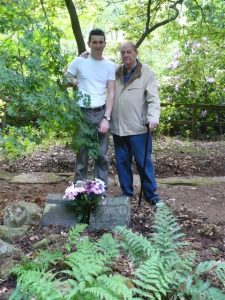
    Pat & Alex
    Seskinore Garden of Remembrance

    A Life Reconnected

    Patrick (“Pat”) Joynson-Wreford’s later years were shaped by reflection, rediscovery, and an unexpected return to a family story from which he had long been separated.

    For most of his life, that story had been unknown to him.

    But following his reunion with his half-sister Xenia in 2004, Pat became closely connected not only with her, but with the wider history of his father and Seskinore. What had once been distant and unknowable gradually became real.


    Later Life

    In the years after their meeting, Pat remained in regular contact with Xenia and took part in visits to Seskinore.

    These visits were not a return to a remembered past, but an encounter with a life he had only discovered late in life—a landscape that had shaped his father, yet had played no part in his own upbringing.

    Even so, the connection deepened.


    Declining Health

    By 2012, Pat’s health began to deteriorate. Periods of confusion led to a diagnosis of Alzheimer’s disease.

    Despite this, he retained much of what had always defined him:

    • a strong sense of identity
    • warmth in his relationships
    • and a characteristic humour that remained with him even as his condition progressed

    Return, Reunion, and Letting Go

    In August 2012 the story of Seskinore drew together once more—this time not through inheritance, but through rediscovery.

    Pat arranged for Xenia to travel from Australia. She stayed for just over six weeks, and during that time we returned together to Seskinore, spending several days walking the grounds that had once shaped her earliest life.

    It was not an easy visit. Being away from familiar routines proved difficult at times, yet there were still moments of warmth and quiet joy—fragments of connection in a place that had long since changed.


    Rebuilding the Family

    During that same visit, Xenia and I travelled to Surrey to meet relatives with whom we had only recently been in contact.

    Xenia and Julia with the portrait of Dora McClintock

    Julia Chessun (née Mathews) and her husband Stewart had organised a large family gathering. It was a remarkable day—filled with conversation, shared memories, and the gradual weaving together of a family long separated.

    Julia generously shared a collection of family portraits and photographs, many of which were carefully preserved and later added to the McClintock archive.

    From Surrey, we travelled on to Bristol, where Xenia’s cousin David Stewart and his wife Bridget welcomed us.

    Once again, a gathering had been arranged.

    It was another day of warmth and recognition—of names gaining faces, and stories finding their place. David, too, had preserved a wealth of family memorabilia, offering further pieces of a history that had once been hidden.


    The Last Estate Decisions

    Amid these reconnections, attention turned once more to Seskinore itself.

    Xenia raised again the question of selling McClintock Primary School, a property she had only discovered she owned during earlier research.

    At the time, it had seemed sensible to retain it. The school provided a steady income, and as an unexpected inheritance, it required little from her. But circumstances—and time—had changed.

    The market had slowed, yet there remained the possibility that the site would appeal to a long-term investor.

    It was at this point that I recognised my role had reached its natural conclusion.

    The research was complete. The titles had been clarified. The legal and estate matters had been brought into order.

    What remained was no longer discovery—but responsibility.

    And that belonged to Xenia, and to the next generation.


    Handing Over

    All documents, records, and correspondence were passed to her.

    The land agent in Belfast was informed that I would no longer act on her behalf. From that point forward, the management of the property rested entirely with Mrs Lewis.

    It marked a quiet but important transition—from recovery of the past to stewardship of what remained.


    Final Years

    After Xenia returned to Australia, contact became less frequent, though it never entirely ceased.

    Updates continued—particularly about Pat.

    In October, he suffered a fall at home, fracturing his hip. It became clear he could no longer live independently. In January 2013, he moved to Westerton Care Home in Bearsden, where he was well cared for and remained content.

    Though his general condition stabilised for a time, his underlying illness continued its slow progression.


    The End of an Era

    In 2018–2019, Xenia made the decision to sell the school.

    With that sale, a final link to the estate passed out of Perry–McClintock hands.

    After nearly three centuries, the last tangible holding at the heart of Seskinore village left the family.


    Legacy

    What remained was no longer land or buildings—but memory.

    The estate had been fragmented, the house demolished, and the lands dispersed.

    Yet through rediscovery, reunion, and the careful gathering of its history, Seskinore had not been lost.

    Its story—once scattered—had been brought back together.

    And in that sense, the ending was not one of disappearance,

    but of return.


    Death and a Final Wish

    Pat died peacefully on 19 August 2015, aged 87.

    Before his death, he made a final and deeply significant request:

    That he be cremated, and that his ashes be buried beside his father at Seskinore.

    It was a place he had not known in childhood—
    but one that had come to hold meaning in his final years.


    Return to Seskinore

    In May 2016, that wish was fulfilled.

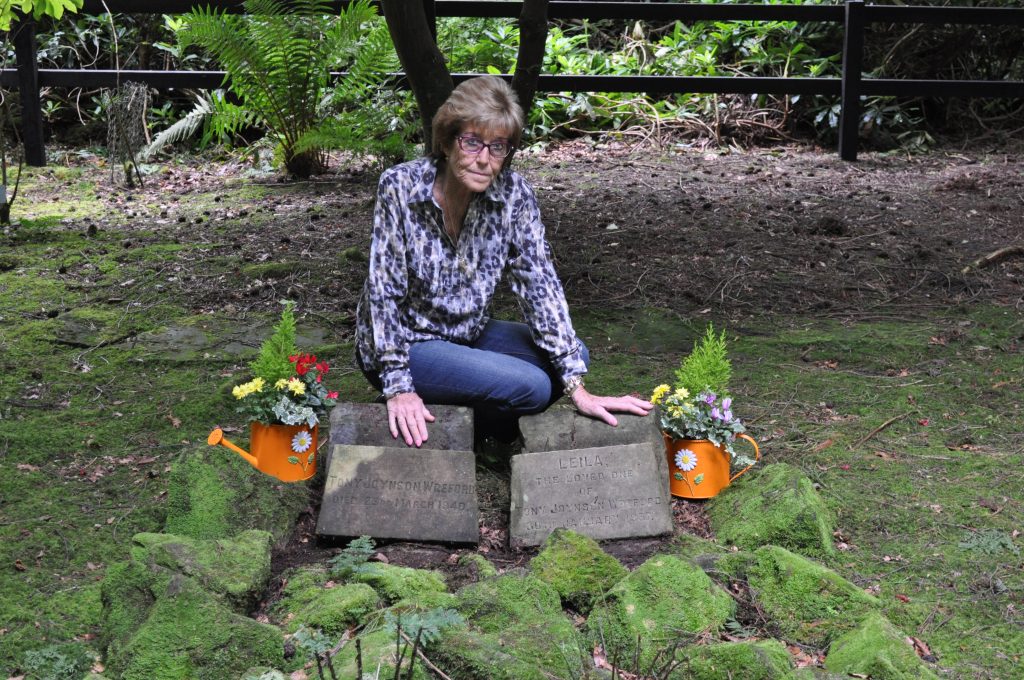
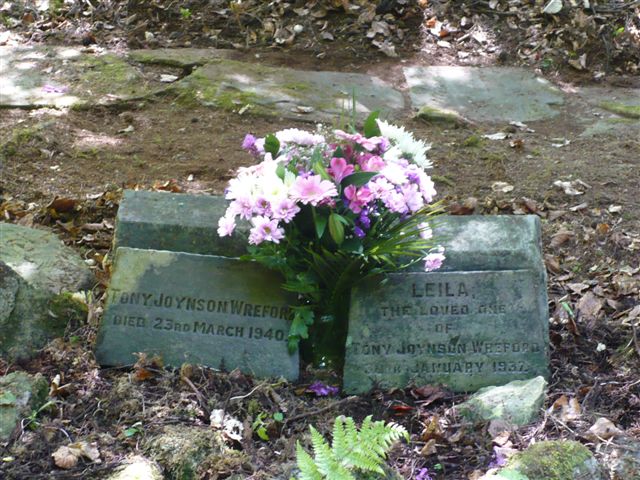
    His ashes were laid in the Garden of Remembrance, beside the grave of his father, Tony Joynson-Wreford, and close to that of Leila McClintock.

    For the first time, Patrick became physically part of the place that had once defined his father’s life.


    Closing the Circle

    Pat’s story came full circle.

    A man who had grown up knowing almost nothing of his father—
    who had never heard of Seskinore, nor of the McClintock family—
    was, in the end, laid to rest at the heart of that history.


    Significance

    Patrick Joynson-Wreford’s life reflects the fragmentation—and eventual recovery—of family memory.

    His search did not simply uncover facts.
    It restored connections:

    • between father and son
    • between past and present
    • and between lives long separated by silence

    His return to Seskinore, even in death, marks one of the final and most poignant chapters in the story of the estate.


    👉 See also:

  • Tony Joynson-Wreford’s Will and the Sale of Seskinore (1939–1952)

    Tony Joynson-Wreford’s will, signed on 18 March 1939, laid out careful provisions for the guardianship and financial security of his young daughter, Xenia, at a time of growing uncertainty, as Europe stood on the brink of the Second World War.

    Originally, he had appointed Captain Anthony C. S. Delmege—Leila’s cousin—and Lady Marjorie Edith Hare as Xenia’s guardians. However, by codicil dated 16 March 1940, just one week before his death, he revoked that arrangement and instead named his close friend Lieutenant-Commander John H. T. Boteler and Boteler’s wife, Sheila (née Hooper), as guardians.

    It seems likely that Tony’s decision was influenced by the uncertain wartime future. Having already suffered losses during the First World War, including the death of his brother Bertran, he may have feared that Captain Delmege, as an active serviceman, would not be able to provide stable long-term care.

    These decisions, made in the final days of his life, would shape not only Xenia’s upbringing, but the future of the Seskinore estate itself.


    Provision for Xenia

    The will established a trust to support Xenia’s upbringing and education until she reached the age of 21.

    To make this possible, Tony gave the trustees authority to sell Seskinore House if necessary.

    This provision would prove decisive in the fate of the estate.


    Sale of Seskinore House

    1940 Seskinore sale map

    In 1941, Seskinore House, together with 115 acres, 1 rood and 19½ perches, was sold to the Ministry of Agriculture.

    Importantly, the sale excluded the Garden of Remembrance where Leila was buried. Rights of access for members of the McClintock family were also preserved, ensuring that this deeply personal part of the estate remained protected even as the wider property passed out of family hands.

    Although the Ministry acquired the estate, they ultimately found no practical use for the great house. Over time, the building fell into disuse and disrepair.


    The End of the House

    In 1952, Seskinore House was demolished.

    A report in the Belfast Telegraph captured the stark reality of its final years with the headline:

    “The end of a house that nobody wanted. 30-room Ulster mansion to go.”

    With its demolition, the historic seat of the McClintock family—built up over generations—was brought to an end. Only the courtyard and outbuildings survived, standing as quiet remnants of what had once been a major country estate.

    Site of Seskinore House


    Significance

    Tony Joynson-Wreford’s will shaped the final fate of Seskinore.

    It determined the guardianship of Xenia, created the trust under which the estate was managed, and enabled the sale that brought an end to Seskinore House as a family residence.

    At the same time, by preserving the Garden of Remembrance and access rights to it, the will ensured that the most personal part of the estate would remain connected to the family even after the house itself was gone.


    Primary Source

    A full transcription of Tony Joynson-Wreford’s will and codicil is available here:


    See also:

    Continue the Story

    The Break-Up of the Seskinore Estate
    Xenia’s Early Life: Guardianship, Separation and Silence
    Xenia’s Life Beyond Seskinore
    Tony Joynson-Wreford: Final Years and Devotion to Leila
    The Garden of Remembrance at Seskinore


  • The Garden of Remembrance at Seskinore

    The Garden of Remembrance at Seskinore occupies a unique place in the history of the estate. Unlike the house, the lands, and much of the demesne, it was neither abandoned nor lost, but preserved as a place of personal and historical continuity.
    Origins

    The garden originated in the childhood of Amelia (Leila) Isobel Eccles McClintock.

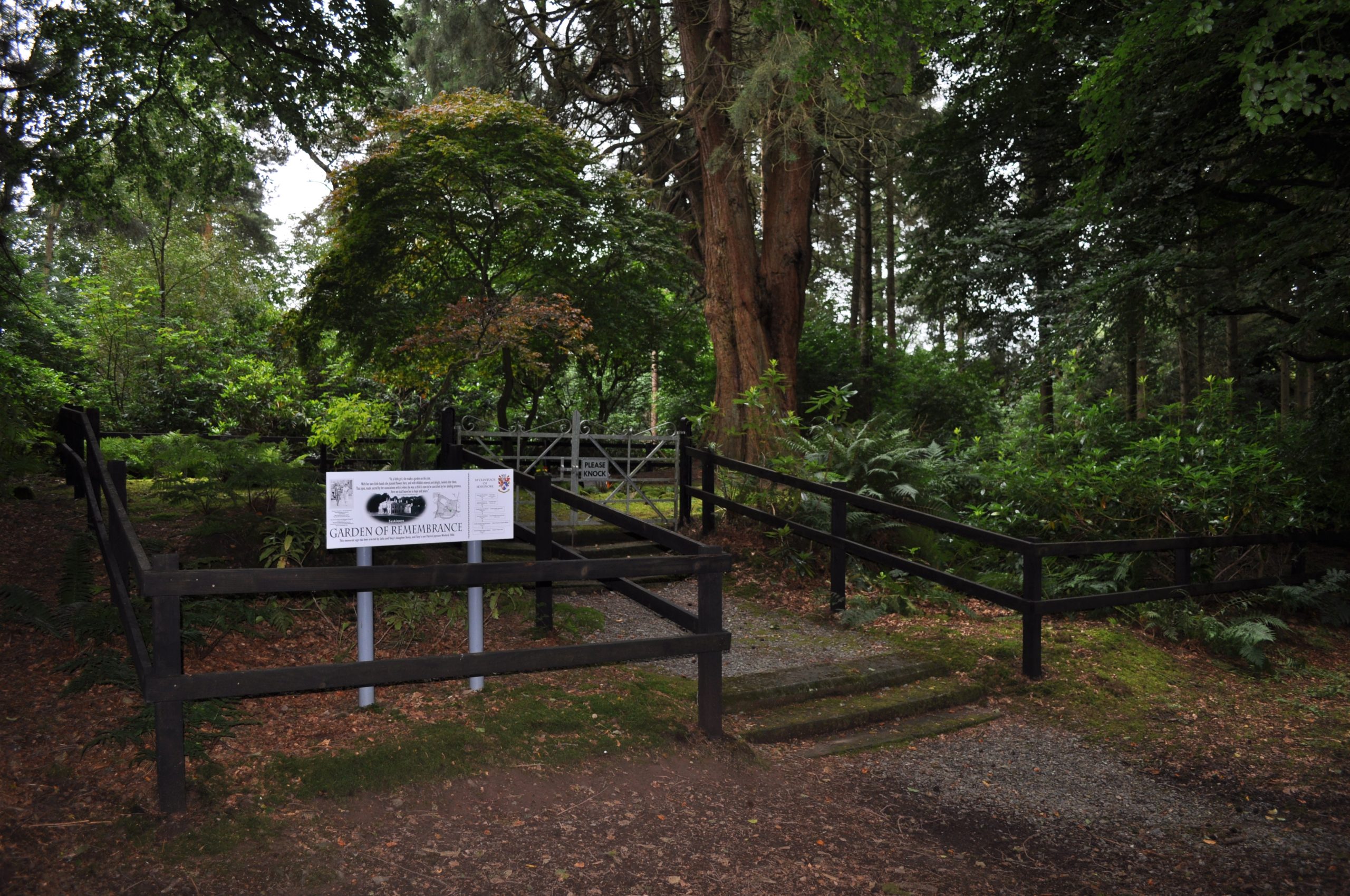
    As a young girl, she created a small garden of her own near the house, setting it apart as a private space. At its entrance, she placed a sign bearing the words:

    “Please Knock.”

    This simple detail reflects both the character of the child and the sense of ownership she felt over the space.


    A Place of Burial

    Following her death in January 1937, this same garden was chosen as her place of burial.

    Rather than being interred in the formal family burial ground, she was laid to rest in the space she had created herself—a decision that gave the garden a deeply personal significance.

    At the time of her burial, the connection between her childhood and her final resting place was noted in the words spoken there:

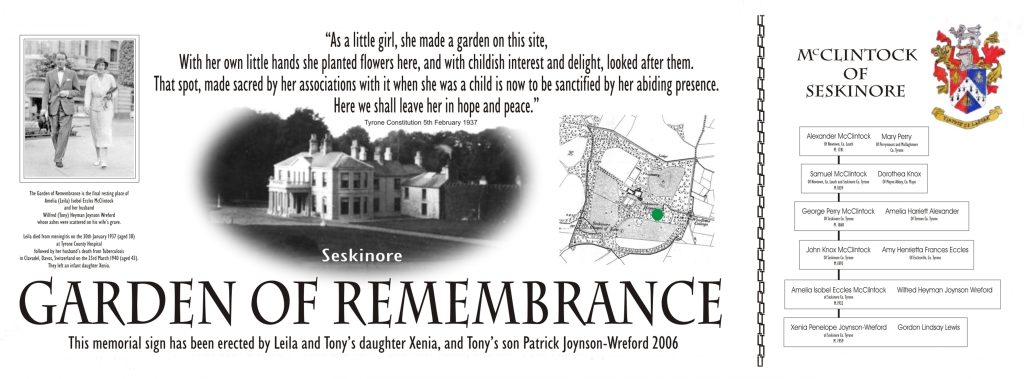
    “As a little girl, she made a garden on this site…
    That spot, made sacred by her associations with it when she was a child is now to be sanctified by her abiding presence.”


    Tony Joynson–Wreford

    Following Leila’s death, her husband, Captain Wilfred Heyman Joynson–Wreford, formed a strong and lasting attachment to the garden.

    Each evening, he would walk to the garden and sit beside her grave, often remaining there for extended periods. His daily visits became part of the life of the estate during its final years as a family residence.

    In his will, he made specific provision for the preservation of the garden, stating that access should be retained for members of both his own family and the McClintock family, and that the garden should be maintained in perpetuity.

    He further expressed the wish that his ashes should be scattered there.


    Preservation Through Change

    The importance of the garden was recognised even as the estate itself was being broken up.

    When Seskinore House and surrounding lands were sold in 1941, the Garden of Remembrance was specifically excluded from the sale. Rights of access were retained, ensuring that it would remain connected to the family despite the transfer of ownership.

    This decision set the garden apart from the wider fate of the estate.


    Final Resting Place

    Following Tony’s death in Switzerland in 1940, his ashes were eventually returned to Seskinore.

    After the end of the Second World War, they were interred beside Leila in the garden. A simple memorial stone was placed alongside hers, marking their final resting place together.


    The Garden Today

    Although the house at Seskinore was demolished in 1952, the Garden of Remembrance survived.

    It remains one of the most significant surviving elements of the estate:

    • A place of burial
    • A link between generations
    • A physical reminder of the personal history of the family

    Unlike many features of the estate, which have been lost or altered, the garden continues to preserve its original purpose.


    Restoration and Remembrance

    In later years, the Garden of Remembrance continued to hold deep significance for those connected with the history of Seskinore.

    On:

    28 October 2006

    a commemorative sign was erected within the garden to mark the resting place of:

    • Leila McClintock
    • and Captain Tony Joynson-Wreford

    The intention was not only to identify the secluded burial place hidden within the woodland, but also to preserve the memory of those associated with it for future visitors to the estate.

    The project brought together members of the extended family, including:

    Anthony Patrick (“Pat”) Joynson-Wreford

    and

    Penelope (“Xenia”) Joynson-Wreford

    who jointly agreed to fund the sign as a lasting memorial.

    The plaque was designed by my friend Jim Kelly who created a simple and understated design centred upon an interlaced chain of the initials:

    “L & T”

    symbolising the bond between Leila and Tony Joynson-Wreford.

    The memorial also included:

    • a short account of their lives
    • and a small ancestry diagram placing them within the wider history of the Seskinore family.

    The installation of the sign became a significant moment in the continuing rediscovery and preservation of Seskinore.

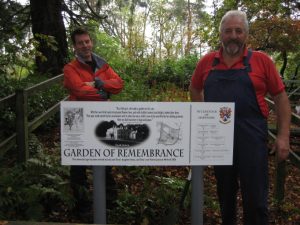
    On a cool autumn day, family members travelled to the garden carrying cement, tools, brushes, and materials needed for the work. Among those present were my mum, dad, and Peter, all of whom assisted in the installation.

    My dad carefully prepared the ground and dug the post holes, and before long the sign stood securely in place among the trees surrounding the graves.

    Quietly positioned within the woodland, it became more than a marker alone. It stood as:

    • a memorial
    • a gesture of remembrance
    • and a continuation of the connection between the family and Seskinore itself.

    In a landscape where so much has disappeared, the Garden of Remembrance remains one of the few surviving places where the personal history of the estate can still be directly felt.


    Return to Seskinore (2008)

    On:

    2 June 2008

    Xenia Joynson-Wreford, Pat Joynson-Wreford, and I returned together to Seskinore, staying for several days at nearby Greenmount Lodge.

    By this time, Pat’s health had begun to decline following a stroke in 2006, and considerable care was taken throughout the journey to ensure that he could comfortably revisit the places so closely connected with his family history.

    During the visit we met with:

    • Lisa Morgan
    • and Roisin Anagnostides

    with whom I had worked for several years in identifying and helping secure the registration of surviving residual properties associated with the Seskinore estate.

    The work had become more than a legal or administrative exercise. It formed part of a wider effort to reconstruct and preserve the fragmented remains of the estate and its history.

    Later that day we travelled to:

    The Garden of Remembrance

    bringing the car as near as possible to allow Pat to make the short walk through the woodland.

    The forest retained its familiar stillness, and as we approached the garden both Pat and Xenia paused quietly, taking in the scene before them.

    The memorial sign erected in 2006 now stood firmly in place among the trees. Its understated design, centred upon the interlaced initials:

    “L & T”

    continued to mark the memory of:

    • Leila McClintock
    • and Tony Joynson-Wreford

    and their enduring connection with Seskinore.

    Nearby stood the renewed garden gate, reconstructed in galvanised aluminium to withstand the passage of time while preserving the character of the original entrance.

    For both Pat and Xenia, the return to the garden represented more than a visit alone. It formed part of a renewed connection with a place deeply bound to family memory, loss, and continuity across generations.


    Final Visit (2012)

    In the summer of:

    2012

    Xenia Joynson-Wreford returned once more to Seskinore, accompanied by family members during what would become her final visit to the estate and to the Garden of Remembrance.

    By this stage, the rediscovery and restoration of Seskinore’s surviving history had already been largely achieved. The remaining visits carried a quieter character — less concerned with research or recovery, and more with reflection, memory, and personal connection.

    During this final return, Xenia again visited:

    The Garden of Remembrance

    where the graves of:

    Leila McClintock
    and Captain Tony Joynson-Wreford

    remained sheltered beneath the trees of the old demesne woodland.

    The garden, preserved through decades of change and loss, continued to represent one of the most personal surviving links to the family’s history at Seskinore.

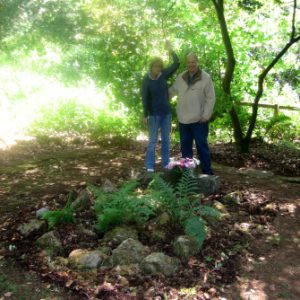
    A photograph taken during this final visit captures Xenia within the landscape so closely connected to her family story — a final return to a place which, after many years of separation, had once again become part of her life.


    Significance

    The Garden of Remembrance stands apart within the history of Seskinore.

    It represents:

    • Continuity in the midst of change
    • The personal dimension of estate history
    • The enduring connection between place and memory

    While the estate itself has been transformed, the garden remains a focal point through which its history can still be understood.


    See also:

  • The McClintock Succession from Perry to Joynson–Wreford

    The history of the Seskinore and Mullaghmore estates can be understood through a continuous line of succession linking the Perry, McClintock, Eccles, and Joynson–Wreford families.

    This succession reflects the transfer of ownership through marriage, inheritance, and family alliance over several generations.


    The Perry Foundation

    The estate at Mullaghmore (Perrymount) was established in the seventeenth century by the Perry family, beginning with James Perry following land grants in 1662.

    The Perrys remained in possession of the estate throughout the eighteenth century.


    Transfer to the McClintock Family

    The transfer of the estate to the McClintock family occurred through the marriage of Mary Perry, daughter of Samuel Perry of Perrymount, to Alexander McClintock of Newtown, County Louth, in 1781.

    Following the death of George Perry (1762–1824), the estate passed under the terms of his will to his nephew, Samuel McClintock.


    Samuel McClintock (1790–1852)

    Samuel McClintock established the family’s residence at Seskinore and took possession of the estate in 1845.

    His tenure marked the consolidation of McClintock ownership following the earlier Perry period.


    George Perry McClintock (1839–1887)

    His son, George Perry McClintock, continued the estate during the later nineteenth century, maintaining its position within the landed structure of County Tyrone.

    His name preserved the connection to the Perry family.


    Colonel John Knox McClintock (1864–1936)

    The next generation is represented by Colonel John Knox McClintock, whose name reflects the continued influence of the Knox family through his grandmother, Dorothea Knox.

    He maintained the estate into the early twentieth century.


    The Eccles Connection

    Through the marriage of Colonel John Knox McClintock to Amy Henrietta Eccles of Ecclesville, the Eccles family became integrated into the succession of the estate.

    Their daughter, Amelia (Leila) Isobel Eccles McClintock, became the sole heir.


    Transfer to the Joynson–Wreford Family

    Through her marriage to Wilfred (Tony) Heyman Joynson–Wreford, the estate passed into the Joynson–Wreford family.

    Their daughter, Xenia Penelope Joynson–Wreford (b. 1935), represents the continuation of this line.


    Significance

    This succession demonstrates:

    • The transfer of estate ownership through marriage alliances
    • The integration of multiple family lines across generations
    • The preservation of family identity through naming (Perry, Knox, Eccles)

    It represents the complete genealogical pathway of the estate from its establishment in the seventeenth century through to its later ownership in the twentieth century.


    See Also:

  • George Perry (1762–1824) and the Final Phase of Perry Ownership

    George Perry of Perrymount, born in 1762, represents the final principal figure of the Perry family in possession of the Mullaghmore estate.

    He served as a Cornet of Horse and inherited the estate during a period of transition following the death of earlier members of the family.


    Marriage and Connections

    George Perry married Mary, daughter of John Burgess of Parkanaur, County Tyrone.

    This marriage is significant in explaining his later association with Armagh, as lease records indicate that he held property from his brother-in-law, John Henry Burgess, and was described in documents between 1805 and 1811 as “of Armagh.”


    Residence and Estate Management

    Although Mullaghmore (Perrymount) remained the ancestral seat, this period appears to have marked a shift in residence and estate management.

    Lease records suggest that the Perrymount estate may at times have been occupied or managed by others, including connections within the Lowry family.


    Death and Succession

    George Perry died in 1824 without surviving issue.

    In his will, dated 15 May 1823, he directed that his estate should pass:

    • to his wife Mary Perry for her lifetime
    • thereafter to his nephew Samuel McClintock for life
    • with remainder to the heirs of Samuel McClintock


    Significance

    The will of George Perry represents the decisive moment in which the Mullaghmore and Seskinore estates were formally directed out of the Perry family and into the McClintock line.

    Although the transfer was structured through life interests, it ensured the long-term continuation of the estate under McClintock ownership.

    This marks the end of direct Perry control of the estate and the beginning of a new phase in its history.


    See Also:

  • The 1774 Sale of Mullaghmore and the Estate of Samuel Perry

    The following notice is reproduced in full from the Londonderry Journal, 4 March 1774, relating to the sale and letting of the Mullaghmore (Perrymount) estate following the death of Samuel Perry.

    Extract from the Londonderry Journal (4 March 1774)


    “To be sold by public cant at Mullaghmore in the County of Tyrone on Monday the fourteenth day of March inst.

    All the household furniture which belonged to Samuel Perry, Esq., deceased, a considerable part of which has been but a short time in use; as also the farming utensils and stock of cattle belonging to the demesne of Mullaghmore, the stock consisting of several saddle and ‘draft’ horses, some extraordinary good milch cows, and other cattle. Six months credit will be given upon approved of security for every article above 20s. To be set also during the minority of the heir who is now about ten years of age, together or in parcels, and to be entered on immediately, the house offices and demesne of Mullaghmore; the house is large and in good order with stables coach-house and other offices, fit for the accommodation of a gentleman or farmer. The demesne consists of about eight plantation acres of arable and meadow ground, well enclosed into parks with quickest hedges in the high condition and well circumstanced as to firing, there being some hundred acres of turf bog in the farm; several acres are ‘plowed’ this season and any tenant that would take immediately may be accommodated at a reasonable value with turf hay and oats. It is situated about five miles from Omagh seven from Augher and three of Fintenagh good market towns to which the roads are very good. Proposals be received by Mr Samuel Galbraith of Greenmount near Omagh; a servant on the land will show the premises to any person inclined to take them.

    All person to whom the said Samuel Perry was indebted are desired to furnish their accounts and the nature of their demands to the said Samuel Galbraith one of the executors, that they may be discharged and to enable the executors to do which, all persons who were indebted to the said Samuel Perry are desired immediately to pay such debts to the said Samuel Galbraith, Wybrants Olpherts or James Hamilton, Attorney, the executors or either of them.”

    Source: Londonderry Journal, 4 March 1774


    This notice provides a contemporary description of the Mullaghmore estate at the time of Samuel Perry’s death, including its house, demesne, and agricultural stock.


    See Also:

  • Marriage of Mary Perry and the McClintock Connection

    A key moment in the transfer of the Mullaghmore and Seskinore estates occurred through the marriage of Mary Perry, daughter of Samuel Perry of Perrymount, to Alexander McClintock of Newtown, County Louth, in December 1781.

    Alexander McClintock (b. 1746) was the nephew of Alexander McClintock of Drumcar. Through this marriage, the Perry estate became linked to the McClintock family, establishing the basis for its eventual transfer through inheritance.

    The significance of this marriage became fully apparent in the early nineteenth century, when George Perry (1762–1824), who died without surviving issue, directed in his will that the estate should pass to his nephew Samuel McClintock for life, with remainder to his heirs.

    This arrangement ensured that the Mullaghmore and Seskinore estates would pass out of the Perry family and into the possession of the McClintocks, marking a major transfer in ownership and continuity of the estate.


    See Also: