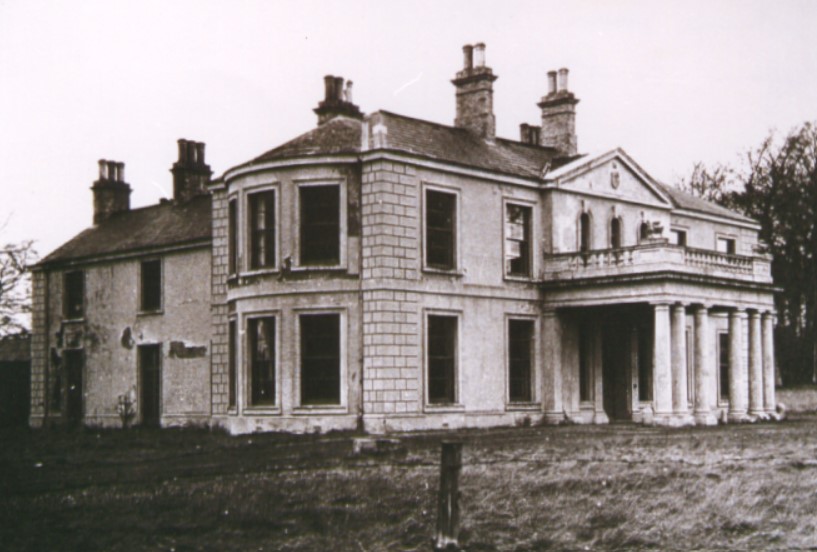
The Decline and End of the Seskinore Estate (1936–1952)
Introduction
The final decline of the Seskinore estate began not with demolition, but with a succession crisis.
For more than two centuries, Seskinore and Mullaghmore had formed the centre of a substantial landed estate associated successively with the Perry, McClintock, and Joynson-Wreford families. By the mid-twentieth century, however, both the family succession and the wider economic foundations of the estate were beginning to collapse.
The decisive turning point came between 1936 and 1937.
On 24 October 1936, Colonel John Knox McClintock died at Seskinore. Under the McClintock marriage settlement of 1893, the remaining settled estate passed to his only child, Amelia Isobel Eccles Joynson-Wreford (“Leila”), wife of Captain Wilfred Heyman (“Tony”) Joynson-Wreford.
Leila’s inheritance was tragically brief.
After only about three months as heir to Seskinore, she died from meningitis on 30 January 1937.
Her death abruptly ended the direct McClintock succession at Seskinore and fundamentally altered the future of the estate.
Under her will, dated 22 January 1935, Leila appointed her husband Tony sole executor and left to him:
“all my real and personal estate whatsoever and wheresoever … absolutely”
A series of Settlement and Conveyance documents executed during 1937–1938 subsequently transferred the remaining Seskinore lands, mansion house, investments, and trust funds into Tony’s ownership, formally winding up the old McClintock settlement structure.
The transfer marked the final passage of Seskinore from the McClintock family into the Joynson-Wreford line.
Yet the inheritance came at a moment when the traditional landed estate system itself was entering irreversible decline.
Across Ireland, estates such as Seskinore were becoming increasingly difficult to sustain. The economic foundations of country house life — tenant rental income, large-scale domestic service, and unified estate management — had been steadily weakened through the Irish Land Acts, rising taxation, reduced agricultural profitability, and the changing social realities of the twentieth century.
The years that followed saw the gradual fragmentation of the estate:
- the sale of portions of Mullaghmore,
- the dispersal of household contents,
- attempts to sell the house,
- the transfer of lands through the Land Commission,
- and ultimately the demolition of Seskinore House in 1952.
What disappeared was not simply a building, but the end of an estate world that had shaped the landscape and society of this part of County Tyrone since the seventeenth century.
The 1937–1938 Settlement and Conveyance
The legal transition of the estate following Leila’s death can be traced through a remarkable series of surviving settlement and conveyance documents executed between December 1937 and February 1938.
These papers formally wound up the McClintock marriage settlement created in 1893 upon the marriage of John Knox McClintock and Amy Henrietta Eccles.
The documents confirm that after Leila’s death:
- Tony became entitled to the remaining settled lands,
- the trust structure was dissolved,
- Amy Henrietta (“Emy”) McClintock’s annuity arrangements were commuted,
- and the remaining estate assets were transferred into Tony’s direct ownership.
The conveyances identify surviving estate lands in:
- Mullaghmore,
- Tullyrush,
- and Seskinore,
together with the mansion house and associated properties.
The papers also reveal surviving estate investments and securities still held within the settlement, including government stock, land bonds, and cash funds.
Among the trustees involved were:
- Captain James Gildea Browne,
- and Captain Hugh Charles Godfrey Stewart,
both closely connected with prominent Tyrone landed families.
The documents therefore represent the final legal dismantling of the nineteenth-century McClintock settlement structure and the last major transfer of Seskinore before the estate entered its terminal period of decline.
The Sale of Mullaghmore Lands
The decline of the estate affected not only Seskinore itself, but also the wider lands at Mullaghmore (historically Moyloughmore and later Perrymount), which had originally formed the core of the Perry estate before passing into McClintock and later Joynson-Wreford ownership.
By the twentieth century, Mullaghmore had ceased to function as the principal family residence and had become primarily agricultural in character.
Shortly before his death in 1940, Captain Wilfred Heyman Joynson-Wreford sold more than 227 acres of Mullaghmore land to the Ministry of Agriculture. This represented one of the earliest formal stages in the break-up of the estate.
The transfer formed part of a wider programme of agricultural reorganisation and land redistribution.
Symbolically, it marked the final separation of the estate from its original Perry seat at Perrymount.
Seskinore Offered for Sale
Following the death of Captain W. H. Joynson-Wreford in 1940, attempts were made to secure a future for Seskinore through sale.
The estate was advertised by private treaty as:
“A BEAUTIFUL COUNTRY RESIDENCE WITH ABOUT 120 ACRES LAND”
The advertisement described the house as containing:
“Large Entrance Hall, Inner Hall, Drawing Room, Dining Room, Library, Smoke Room, 11 Bedrooms, Servants’ Apartments, Kitchen, Sculleries, Pantries, &c.”
It also referred to:
“beautiful surroundings with nicely laid-out grounds and gardens”
together with extensive outbuildings and estate cottages.
The notice reveals that, even in its final years, Seskinore still retained much of the appearance and structure of a functioning landed estate. Yet it also reflected a wider reality affecting country houses throughout Ireland and Britain during the post-war period.
Estates built upon older systems of landholding and domestic service had become increasingly difficult to maintain, and despite attempts to secure a purchaser, Seskinore failed to find a sustainable long-term future.
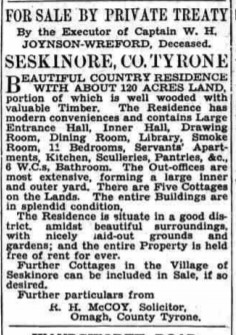
Caption:
Advertisement offering Seskinore for sale by private treaty following the death of Captain W. H. Joynson-Wreford.
The Death of Tony Joynson-Wreford
The final blow to the continuity of the estate came with the death of Captain Wilfred Heyman (“Tony”) Joynson-Wreford on 23 March 1940 at the Kurhaus, Clavadel, Switzerland, where he had been receiving treatment for tuberculosis.
Having inherited Seskinore only three years earlier following the death of his wife Leila, Tony’s death left their daughter Xenia as the ultimate heir. Still a young child, she was unable to assume any practical role in the management of the estate.
The years that followed witnessed the gradual dispersal of the contents, sale of lands, and eventual disappearance of Seskinore House itself.
Dispersal of the Contents of Seskinore House
Following the death of Captain Joynson-Wreford in 1940, the contents of Seskinore House appear to have been dispersed prior to the eventual decline and sale of the estate.
Evidence for this survives in a later article written in approximately 1949, which records that a bound volume entitled:
“Maps of the Estate of Samuel McClintock, Esq., Situate in the Counties of Armagh, Louth, Meath and Tyrone, by Robert Wilson.”
came into private hands:
“when the goods and effects of Seskinore Lodge, the former residence of the late Colonel J. K. McClintock, D.L., were disposed of.”
The map volume, dated 1846, was described as a finely bound collection of coloured estate maps and reference schedules naming occupiers and tenants across the McClintock estates.
The surviving maps are now preserved within the Public Record Office of Northern Ireland:
PRONI Reference: D568
Maps of the Estate of Samuel McClintock, Esq., situate in the Corporation of Armagh, Co. Armagh and the Manor of Seskinore, Co. Tyrone, by Robert Wilson (1846).
Although no complete auction catalogue or formal record of the dispersal has yet been identified, surviving recollections suggest that a sale of the furnishings, pictures, silver, books, and household contents of Seskinore Lodge took place during the 1940s.
The apparent dispersal of the collections marked the gradual end of Seskinore as a fully furnished landed estate house and the loss of many objects associated with generations of the McClintock family.
It is hoped that further records, photographs, catalogues, or surviving family material relating to the contents of Seskinore House may emerge in future.
Fragmentation of the Estate
The estate did not disappear suddenly.
Instead, it fragmented gradually over several decades:
- agricultural land passed into private ownership,
- outlying farms and holdings were sold,
- and the remaining estate diminished steadily in scale and coherence.
By the 1950s and 1960s, what had once been a continuous and interconnected estate had effectively ceased to exist as a unified property.
The relationship between Seskinore and Mullaghmore — historically linked since the seventeenth century — was largely dissolved.
“The End of a House That Nobody Wanted”
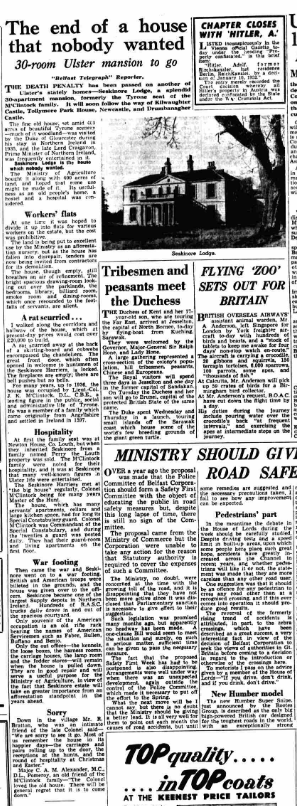
In 1952, the Belfast Telegraph published a striking article describing the final condition of Seskinore House under the headline:
“The End of a House That Nobody Wanted”
The report described the former residence of the McClintock family as a large but increasingly redundant country house which no institution or purchaser had been willing to preserve.
The article noted that various uses had been considered, including:
- an old people’s home,
- a hostel,
- a hospital,
- and workers’ flats,
but none proved financially practical.
The newspaper described empty corridors, shuttered rooms, cobweb-covered chandeliers, and the gradual decay of a house once associated with hospitality, hunting parties, and estate life.
Particular attention was given to the memory of Colonel John Knox McClintock and the former social importance of the house within County Tyrone society.
The article stands as a poignant contemporary record of the final years of Seskinore House and of the wider decline of the Irish country house tradition.
Demolition of Seskinore House
In 1952, Seskinore House was demolished.
Its destruction marked the symbolic end of the estate as a functioning landed centre. Although portions of the estate survived, including the courtyard buildings and associated structures, the principal house itself disappeared from the Tyrone landscape after more than two centuries.
The demolition reflected the fate of many Irish country houses during the mid-twentieth century, when changing economic realities, taxation, declining estate incomes, and reduced domestic staffing rendered such properties increasingly unsustainable.
During the Second World War, the house had briefly returned to active use, with British and American troops stationed within the grounds and buildings. After the war, however, no long-term purpose could be found for the property.
Contemporary reports described it simply as:
“a house that nobody wanted.”
What Remained
Despite the break-up and demolition of the house, important elements of the estate survived.
These included:
- the surviving courtyard and estate buildings,
- portions of the demesne landscape,
- boundary features and estate infrastructure,
- and the Garden of Remembrance established under the terms of Tony Joynson-Wreford’s will.
Equally significant was the survival of the estate in memory, local tradition, photographs, family papers, and archival records.
Significance
The decline and disappearance of the Seskinore estate reflects a wider historical transition within Ireland.
It marked the end of:
- a system of landed ownership rooted in the seventeenth century,
- a way of life centred upon estate, demesne, and hierarchy,
- and the social world associated with the Irish country house.
At the same time, it marked the emergence of:
- modern patterns of land ownership,
- independent farming communities,
- and a fundamentally different rural landscape.
The history of Seskinore therefore forms part of a much broader story — the transformation of Ireland from a society shaped by landed estates into one defined increasingly by smaller ownership and agricultural redistribution.
Related Articles
- Abstract of Title for the Seskinore Estate
- The Perry Family of Mullaghmore, Perrymount and the Origins of the Seskinore Estate
- The Joynson-Wreford Ownership of Seskinore
- 1940 Conveyance to The Ministry of Agriculture
- Tony Joynson-Wreford’s Will and the Sale of Seskinore (1939–1952)
- Amy Henrietta Frances Eccles (1874–1942)
- The End of a House That Nobody Wanted
- The Garden of Remembrance at Seskinore
- Xenia Joynson-Wreford: Early Life, Loss and Rediscovery
- Xenia’s Early Life: Guardianship, Separation and Silence
- Xenia’s Life Beyond Seskinore
- The Recovery of the Seskinore Estate (2005–2007)
- Return to Seskinore (2008): Memory, Restoration and Reunion
- 1914 Inventory & Valuation of Seskinore Lodge