Category: People

  • Tony Joynson–Wreford: Final Years and Devotion to Leila

    Following the death of his wife, Amelia (Leila) Isobel Eccles McClintock in January 1937, Captain Wilfred Heyman Joynson–Wreford remained at Seskinore, profoundly affected by her loss.

    Each evening at six o’clock, he would walk her dog to the “Mistress’ Garden,” the small enclosure where she had been laid to rest. There, beside her grave, he would sit quietly—often for an hour or more.

    Those who worked on the estate later recalled that he never recovered from her death, observing that he appeared to have “not long for this world.”


    Declining Health

    In the months that followed, Tony’s health began to deteriorate.

    Over the next three years, he spent extended periods in various clinics. Letters written between 1938 and 1940 to Andy McHugh, the gardener at Seskinore, provide intimate insight into this period. They reveal not only his worsening condition, but also his continuing concern for the estate and his deep affection for his young daughter, Xenia.

    While convalescing at a nursing home in Barnstaple in late 1938, he learned that the Chapel of Ease at Seskinore had been damaged on Christmas Eve. His sister, Christabel Gladwell, wrote to Andy McHugh conveying the family’s concern on receiving the news.


    Illness and Treatment

    By early 1939, Tony had been diagnosed with tuberculosis.

    In March of that year, he was transferred by air ambulance from Barnstaple Airport to Zurich, and from there to the Kurhaus in Clavadel, near Davos—a well-known sanatorium for tuberculosis patients.
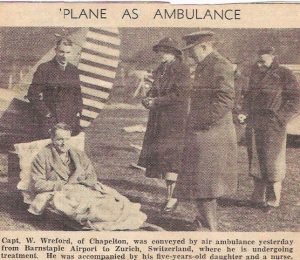
    He was accompanied by his daughter Xenia, his nurse, and Xenia’s nurse, Helen Hunter, affectionately known as “Nursie.”

    A contemporary newspaper report titled “Plane as Ambulance” (Devon & Exeter Gazette, 24 March 1939) recorded this unusual journey, reflecting both the seriousness of his condition and the measures taken to secure treatment.


    Death in Switzerland

    Tony Joynson–Wreford died on 23 March 1940 at the Kurhaus in Clavadel.

    DEATH OF CAPTAIN JOYNSON WREFORD, SESKINORE.

    Intimation has been received in Omagh of the death, which took place in Switzerland. Captain Joynson Wreford, of Seskinore. County Tyrone. Captain Wreford was a son-in-law of the late Colonel .J. K. McClintock. C.B.E., D.L., Seskinore. The late Captain Wreford married the only daughter and heir of Colonel McClintock. His wife died some time ago. His health has been impaired owing to injuries in the Great War. He is survived by a daughter of tender years.

    The Kurhaus, Clavadel

    A postcard from that year depicts the sanatorium as a large, imposing structure set against the Alpine landscape—remote and serene, yet associated with the long and often uncertain struggle of its patients.


    His Final Wishes

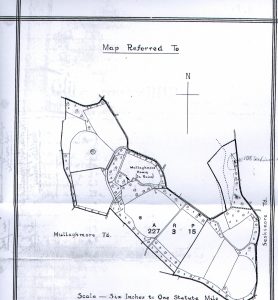
    Shortly before his death he sold part of the Mullaghmore estate (below) containing 227 acres, 3 roods and 15 perches to the Ministry of agriculture.
    In his will, Tony left a deeply personal instruction:

    “IT IS MY WISH that should my Trustees sell or let Seskinore House they should reserve to all members of my family or of the family of McClintock of which my darling Wife was a member the right in perpetuity to enter the said grounds for the purpose of visiting the grave of my said Wife and to keep-up the Garden of Remembrance wherein she is buried.

    IT IS MY WISH that my body should be cremated and that my ashes should be scattered in the said Garden of Remembrance at Seskinore.”


    Return to Seskinore

    Local recollections record that his ashes were returned from Switzerland during the war, though the circumstances of the time delayed their final interment.

    They were placed temporarily within the Chapel of Ease at Seskinore until the end of the war, after which they were laid to rest beside Leila in the garden she had created as a child.

    A simple memorial stone was placed alongside hers, marking their final reunion in the grounds of the estate.


    Significance

    Tony Joynson–Wreford’s final years form one of the most personal chapters in the history of Seskinore.

    His devotion to Leila, his attachment to the estate, and his final wishes ensured that, even after the break-up of the estate, the Garden of Remembrance would remain a place of continuity.


    👉 See also:


  • George Perry McClintock (1839–1887) of Seskinore

    George Perry-McClintock


    George Perry McClintock (1839–1887) of Seskinore succeeded to the estate following the death of his father, Samuel McClintock (1790–1852).

    His name preserved the connection with the Perry family, from whom the estate had originally descended through his grandmother, Mary Perry of Perrymount.

    He continued the management of the Seskinore estate during the later nineteenth century, maintaining its position as an established landed property within County Tyrone.


    Career and Public Life

    George Perry McClintock held a number of prominent military and civic appointments. He served as Lieutenant-Colonel and Honorary Colonel of the 4th Battalion, Royal Inniskilling Fusiliers, and was appointed High Sheriff of County Tyrone in 1865.

    He also served as Aide-de-Camp to the Duke of Abercorn and to the Earl Spencer during their respective terms as Lords Lieutenant of Ireland.


    Marriage and Family

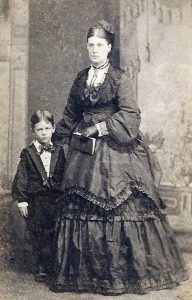
    Amelia Alexander with her son Augustus McClintock

    In 1860, he married Amelia Harriett, daughter of the Rev. Samuel Alexander, Rector of Termon.

    They had issue, including:

    • Beresford George Perry McClintock (1861–1870)
    John Knox McClintock (1864–1936)
    • Augustus McClintock (DSO)
    • and several other sons and daughters


    Significance

    George Perry McClintock maintained the continuity of the estate during a period of relative stability in the later nineteenth century.

    His tenure reflects both the preservation of the Perry inheritance and the continued development of the McClintock family as part of the landed society of County Tyrone.


    See Also:

  • Samuel McClintock (1790–1852) and the Establishment of McClintock Ownership at Seskinore

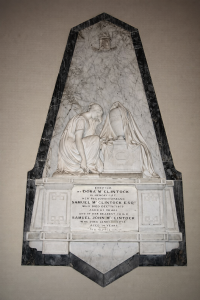
    Memorial to Samuel McClintock, Donacavey Church, Fintona, Co. Tyrone.

    Samuel McClintock (1790–1852) represents the first member of the McClintock family to take full possession of the Seskinore estate following its transfer from the Perry family.

    He was the son of Alexander McClintock of Newtown, County Louth, and Mary Perry, daughter of Samuel Perry of Perrymount, through whom the estate descended.

    Samuel McClintock married firstly Jane Lane, and secondly Dorothea (Dora) Knox, daughter of John Knox of Moyne Abbey. Through these marriages, the McClintock family became further connected with established landed and military families.

    During his tenure, Seskinore was established as the principal residence of the estate and developed as a demesne. The house and its surrounding lands were extended and organised to reflect its role as the centre of estate management, marking a transition from the earlier Perry seat at Mullaghmore to a more modern residence at Seskinore.


    Inheritance

    Under the terms of the will of George Perry (d. 1824), the estate was devised to Samuel McClintock following the lifetime interest of Mrs. Perry.

    He entered into possession of the estate in 1845, an event marked by a well-recorded reception by the tenantry of Seskinore.


    Career and Public Life

    Samuel McClintock served as:

    • High Sheriff of County Louth (1843)
    • A Justice of the Peace
    • A former Lieutenant in the 18th Royal Irish Regiment


    Marriage and Family

    He married:

    • Jane Lane (first wife)
    • Dorothea Knox (second wife), daughter of John Knox of Moyne Abbey

    He had two sons:

    • George Perry McClintock (b. 1819)
    • Samuel John McClintock (d. 1856)


    Significance

    Samuel McClintock established the McClintock presence at Seskinore and oversaw the estate during a key period of consolidation following its transfer from the Perry family.

    His tenure marks the beginning of sustained McClintock residence and control, and the development of Seskinore as the principal seat of the estate.


    See Also:

  • Marriage of Mary Perry and the McClintock Connection

    A key moment in the transfer of the Mullaghmore and Seskinore estates occurred through the marriage of Mary Perry, daughter of Samuel Perry of Perrymount, to Alexander McClintock of Newtown, County Louth, in December 1781.

    Alexander McClintock (b. 1746) was the nephew of Alexander McClintock of Drumcar. Through this marriage, the Perry estate became linked to the McClintock family, establishing the basis for its eventual transfer through inheritance.

    The significance of this marriage became fully apparent in the early nineteenth century, when George Perry (1762–1824), who died without surviving issue, directed in his will that the estate should pass to his nephew Samuel McClintock for life, with remainder to his heirs.

    This arrangement ensured that the Mullaghmore and Seskinore estates would pass out of the Perry family and into the possession of the McClintocks, marking a major transfer in ownership and continuity of the estate.


    See Also: