Perry–McClintock Ownership, Succession and Family Network
Overview
The history of the Seskinore and Mullaghmore estates is defined by a continuous chain of inheritance, marriage alliances, and interconnected landed families extending from the seventeenth century into the modern era.
Originally established by the Perry family of Mullaghmore (Perrymount), the estate later passed through the female line into the McClintock family of Newtown, County Louth, before becoming connected with the Eccles and Joynson–Wreford families in the nineteenth and twentieth centuries.
This page provides an overview of the succession, inheritance, and family network through which the estate evolved over more than three centuries.
Line of Succession
Perry family of Mullaghmore
↓
Mary Perry
married 1781
Alexander McClintock of Newtown
↓
Samuel McClintock (1790–1852)
↓
George Perry McClintock (1839–1887)
↓
Colonel John Knox McClintock (1864–1936)
married 1893
Amy Henrietta Frances Eccles
↓
Amelia (“Leila”) Isobel Eccles McClintock (1898–1937)
married 1932
Captain Wilfred Heyman Joynson–Wreford (1896–1940)
↓
Penelope (“Xenia”) Joynson–Wreford (b. 1935)
Connected Families
The history of the estate is closely connected with a wider network of interrelated landed and professional families, including:
• Perry
• McClintock
• Eccles
• Browne-Lecky
• Stewart
• Lowry
• Sinclair
• Olphert
• Knox
• Burgess (Burges)
• Alexander
• Delmege
• Joynson–Wreford
These connections arose through marriage, inheritance, guardianship, estate administration, and neighbouring landownership.
Perry Foundations
Thomas Perry
d. c.1662
One of the earliest identifiable members of the Perry family associated with the district.
Issue included:
• James Perry (see below)
James Perry Esq., of Ranelly
fl. 1662
In 1662, James Perry received a fee farm grant of the lands of Mullaghmore (Moyloughmore) from Sir Audley Mervyn, establishing the Perry estate in County Tyrone.
From this period onward, the Perry family became established at Perrymount and formed one of the principal landed families in the district.
Issue included:
• Francis Perry, of Tattyreagh (dsp)
• Samuel Perry
• George Perry, of Mullaghmore (see below)
The Perry Family of Perrymount
The principal eighteenth-century representative of the family was:
George Perry (1762–1824)
of Perrymount and Mullaghmore.
He married Mary Burgess, daughter of John Burgess, thereby connecting the estate with the Burges family of Parkanaur and Armagh.
Although George Perry retained ownership of the estate, records frequently describe him as “of Armagh,” reflecting his association with the Burgess family and residence there during part of his lifetime.
Having no surviving issue, George Perry arranged through his will that the estate should pass after the lifetime interest of his widow to his nephew:
Samuel McClintock
son of Mary Perry and Alexander McClintock of Newtown, County Louth.
This transfer ensured the continuation of the Perry estate through maternal descent.
Transition to the McClintock Family
Marriage of Mary Perry and Alexander McClintock
The decisive connection between the Perry and McClintock families arose through the marriage of:
Mary Perry
and
Alexander McClintock of Newtown
in 1781.
Through this marriage, the future inheritance of the estate became linked to the McClintock family.
Following the death of Mrs Perry, the transfer took effect, and in 1845:
Samuel McClintock (1790–1852)
entered into possession of the estate.
Establishment of Seskinore
Under Samuel McClintock, Seskinore emerged as the principal residence of the family.
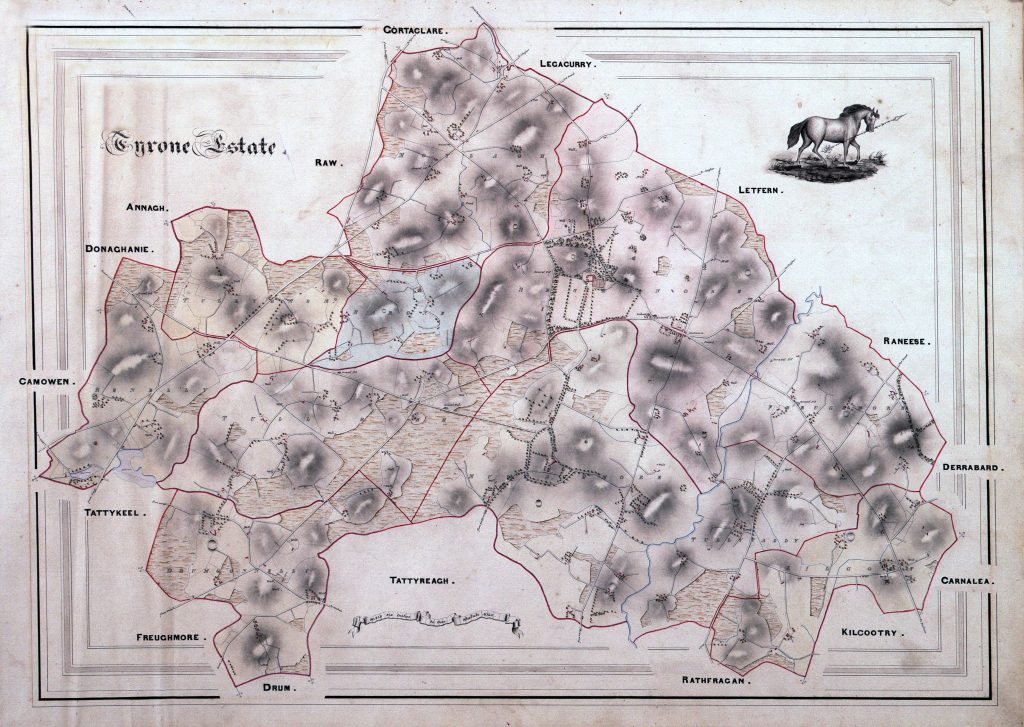
In 1846, a detailed estate map was commissioned, recording the extent and organisation of the property across multiple townlands.
The estate during this period reflected the accumulated acquisitions and inheritances of the preceding centuries and formed one of the more substantial landed properties in the district.
George Perry McClintock
The estate next passed to:
George Perry McClintock (1839–1887)
whose name preserved the memory of the Perry inheritance.
He served as:
• High Sheriff of County Tyrone (1865)
• Lieutenant-Colonel and Honorary Colonel, Royal Inniskilling Fusiliers
• ADC to successive Lords Lieutenant of Ireland
In 1860 he married:
Amelia Harriett Alexander,
daughter of Rev. Samuel Alexander, Rector of Termon.
During his ownership:
• Seskinore House was remodelled and enlarged
• estate life expanded significantly
• the family became increasingly prominent in Tyrone public life
Colonel John Knox McClintock
The next generation was represented by:
Colonel John Knox McClintock (1864–1936)
who inherited the estate in 1887.
He served as:
• High Sheriff of County Tyrone (1891)
• Brevet Colonel during the First World War
• County Commandant, Ulster Special Constabulary
In 1893 he married:
Amy Henrietta Frances Eccles
daughter of John Stewart (or Stuart) Eccles of Ecclesville.
This marriage brought the Eccles family directly into the succession and closely linked the Seskinore and Ecclesville estates.
The Eccles Connection
Through Amy Eccles, the estate became associated with:
• the Eccles family of Ecclesville
• the Browne family of Aughentaine
• the Browne-Lecky family
• the Delmege family
Following the deaths of John Stuart Eccles and his wife Frances Caroline Browne in 1886–87, the Eccles daughters came under the guardianship of their uncle:
Conolly William Lecky Browne-Lecky
creating even closer connections between the families.
Amelia (“Leila”) Isobel McClintock
The only child of John Knox McClintock and Amy Eccles was:
Amelia (“Leila”) Isobel McClintock (1898–1937)
born at:
81 Harcourt Street, Dublin.
Leila represented the final direct McClintock heir associated with Seskinore.
She married:
- Cecil Rhodes Field (marriage dissolved)
- Captain Wilfred (“Tony”) Heyman Joynson–Wreford
Their daughter was:
Penelope (“Xenia”) Joynson–Wreford
born 3 August 1935.
The Joynson–Wreford Transition
The marriage of Leila McClintock to Tony Joynson–Wreford marked the final transfer of the estate into a new family line.
However, this transition occurred during a period of profound social and economic change.
Following:
• the death of Colonel John Knox McClintock (1936)
• the death of Leila McClintock (1937)
• and the death of Tony Joynson–Wreford in Switzerland (1940)
the estate entered its final phase.
Break-Up of the Estate
By the mid-twentieth century, the traditional landed estate system in Ireland was in terminal decline.
The impact of:
• the Irish Land Acts
• tenant purchase
• rising maintenance costs
• taxation
• and changing social conditions
gradually undermined the economic basis of estates such as Seskinore.
In 1941:
• Seskinore House and portions of the estate were sold to the Ministry of Agriculture.
In 1952:
• Seskinore House was demolished.
Over time:
• estate lands were redistributed
• the demesne fragmented
• and the estate ceased to exist as a unified landed property.
Rediscovery and Legacy
Although the estate disappeared in physical form, elements of its history survived through:
• family archives
• photographs
• title documents
• oral memory
• and the surviving landscape
In the early twenty-first century:
Penelope (“Xenia”) Joynson–Wreford
returned to Seskinore, beginning a renewed phase of historical rediscovery and preservation.
Her return reconnected the surviving family line with the estate after many decades of separation.
Chronological Timeline
Perry Foundations
1662
James Perry acquired the lands of Ranelly and Mullaghmore.
1781
Mary Perry married Alexander McClintock of Newtown.
1823
George Perry made his will providing for the transfer of the estate to Samuel McClintock.
McClintock Ascendancy
1845
Samuel McClintock entered possession of the estate.
1846
Estate map commissioned.
1852
Death of Samuel McClintock.
1860
George Perry McClintock married Amelia Harriette Alexander.
1862
Seskinore House remodelled and enlarged.
1873
Chapel of Ease at Seskinore consecrated.
1887
Death of George Perry McClintock.
Eccles and Joynson–Wreford Transition
1893
Marriage of John Knox McClintock and Amy Eccles.
1898
Birth of Leila McClintock.
1913
Ecclesville estate title submitted to the Irish Land Commission.
1932
Leila married Tony Joynson–Wreford.
1936
Death of Colonel John Knox McClintock.
1937
Death of Leila McClintock.
1940
Death of Tony Joynson–Wreford.
Break-Up and Rediscovery
1941
Sale of Seskinore House and lands.
1952
Demolition of Seskinore House.
2005
Xenia returned to Seskinore.
2007
Residual estate interests identified and registered.
2018–19
Sale of McClintock Primary School.
Significance
The history of the Seskinore and Mullaghmore estates illustrates:
• the importance of inheritance and marriage in Irish landed society
• the transmission of estates through interconnected families
• the decline of the traditional estate system in the twentieth century
• and the survival of historical memory long after the disappearance of the estate itself.
From the Perrys of Mullaghmore, through the McClintocks of Seskinore, and finally to the Joynson–Wreford family, the estate remained connected through lineage, memory, and place across more than three centuries.
See Also
• The Perry family of Mullaghmore, Perrymount and the Origins of the Seskinore Estate
• McClintock of Seskinore: Perry Descent and Pedigree
• The Eccles Family of Ecclesville, Fintona and Fermanagh
• Seskinore Estate
• The Decline and End of the Seskinore Estate
• Penelope (“Xenia”) Joynson-Wreford
• The Garden of Remembrance at Seskinore
• Abstract of Title for the Seskinore Estate
• Amelia Harriett McClintock’s Photograph Album
See Also
- The Perry family of Mullaghmore, Perrymount and the Origins of the Seskinore Estate
- Abstract of Title for the Seskinore Estate
- The 1854 Chancery Settlement and Extent of the Estate
- The Burges Family of Parkanaur and Armagh (full family history)
- The Eccles Family of Ecclesville, Fintona and Fermanagh
- Seskinore Estate
- The McClintock Family of Trinta and Newtown
- The Decline and End of the Seskinore Estate (1940-1952)
- Penelope (“Xenia”) Joynson–Wreford
- Amelia Harriett McClintock’s Photograph Album