The Delmege Inheritance: Ecclesville Estate and Cricklade Manor
Final Succession Under the Eccles Entail
The Delmege Inheritance
Under the terms of the will of John Stewart (Stuart) Eccles of Ecclesville, dated 1873, the Ecclesville estate was settled in tail male upon the descendants of his daughters.
Although his eldest daughter, Amy Henrietta Frances Eccles McClintock, became life tenant of the estate, the absence of a surviving male heir meant that the succession would ultimately pass through the male line of her sisters.
This eventually resulted in the succession of:
Colonel Anthony Charles Stuart Delmege (1910–1961)
the son of:
Rose Isabel de Montmorency Eccles
who became the first qualifying male heir under the terms of the entail.
This succession represents the final practical operation of the Eccles entail and the last hereditary transmission of the Ecclesville estate under the original settlement.
The Delmege Family
Rose Isabel de Montmorency Eccles married:
- Major Carfrae Hamilton Delmege (1880–1945)
of Rathkeale, County Limerick, in 1906.
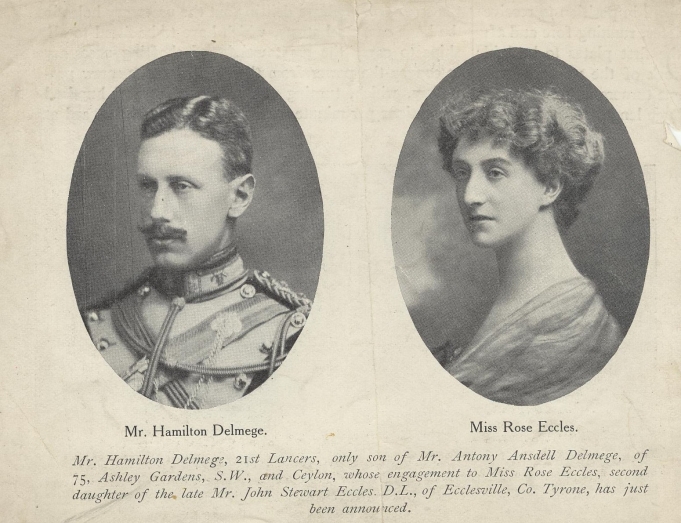
Their children included:
- Anthony Charles Stuart Delmege (1910–1961)
- James Christopher Delmege (1912-1991)
- Sheelagh Edith Delmege (1914-2005)
Through this marriage, the Eccles estate passed into the Delmege family, in accordance with the terms of the entail.
The Delmege Family at Cricklade Manor
Following their departure from Ireland, the Delmege family settled at:
Cricklade Manor, Wiltshire
which they purchased around 1920 and subsequently enlarged.
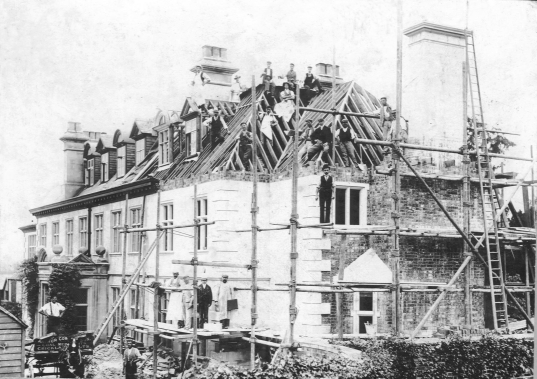
According to material preserved by the Cricklade Museum and the Cricklade Historical Society, the family became well-known figures within the local community during the interwar period.
The Delmeges had intended to retire to India, but circumstances prevented this, leading instead to their establishment at Cricklade.
The family consisted of:
- Major Delmege
- his wife Rose Delmege
- their sons:
- Jim Delmege
- Tony Delmege
- and their daughter:
- Sheelagh Delmege
Rose Delmege died on:
8 May 1929.
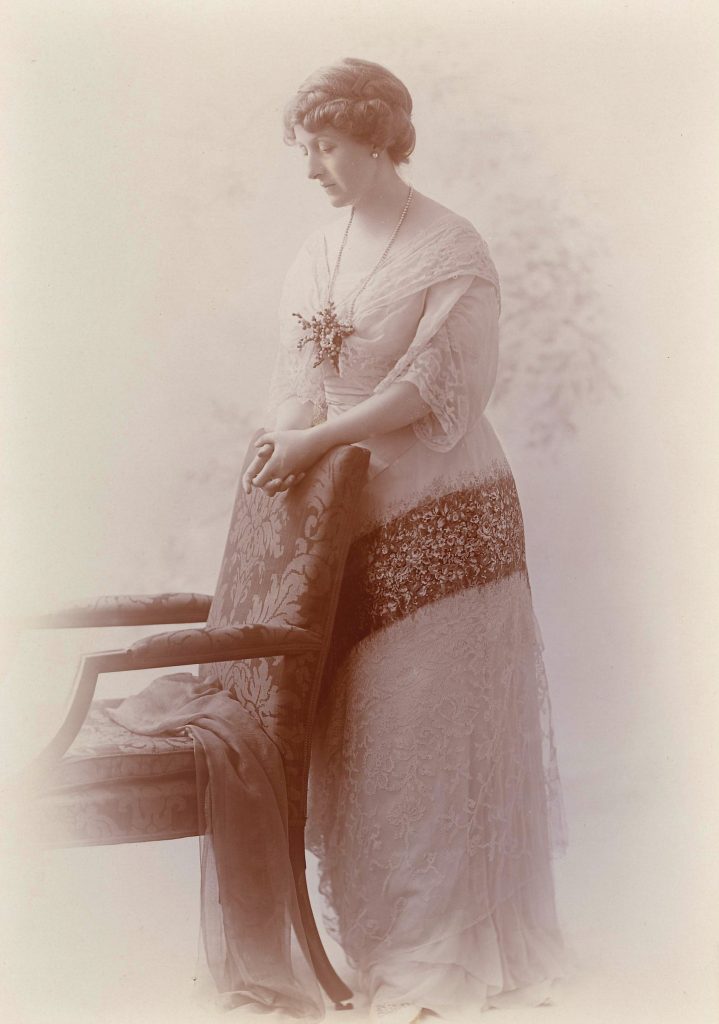
Although regarded as somewhat more private and reserved than earlier occupants of the manor, the family were nevertheless remembered with considerable affection by local residents.
Several members of the Vincent family of Cricklade were employed within the household, serving respectively as:
- governess
- housekeeper
- and lady’s maid.
Mrs Delmege became:
- the first President of the Cricklade Women’s Institute, founded in 1922
- and also President of the Ladies’ Tennis Club.
Local recollections preserved by the Historical Society provide valuable insight into domestic life at the manor during this period.
One account recalled that one of the Delmege sons suffered from tuberculosis during his youth and was frequently seen resting outdoors beneath a canvas shelter in the manor gardens — a common form of treatment for convalescents at the time.
James (“Jim”) Delmege, attended:
Cirencester Agricultural College
where he became master of the college beagle pack.
Sheelagh Edith Delmege
Sheelagh Delmege became a well-known local figure and performed the opening ceremony of the present:
Cricklade Town Hall (1933)
She later married:
Major John Wilder
in a wedding remembered locally for its elaborate decorations, including:
- an awning and red carpet extending from St Sampson’s Church to Bath Road
- floral displays of delphiniums gathered from local gardens
The marriage was tragically short-lived, as Major Wilder reportedly died soon afterwards from complications arising from an infected thorn wound.
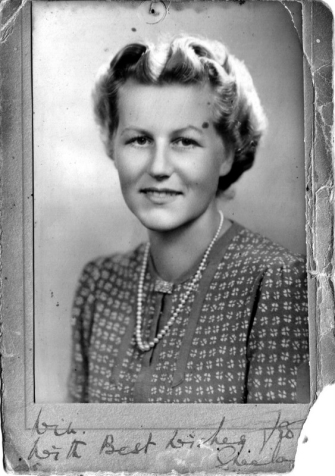
Although her first marriage ended tragically, Sheelagh Delmege later married secondly:
Richard James Kay Fenton
of: Dutton Manor and Clegg Hall
with whom she had issue:
- Jonathan A. S. K. Fenton, b. 1938
- Richard W. H. Fenton (later Delmege), b. 1940
- Patricia Fenton, b. 1943
Sheelagh later married for a third time.
The Delmege surname was later resumed by:
Richard W. H. Fenton (later Delmege)
thus continuing the Delmege line.
Colonel Anthony Charles Stuart Delmege (1910–1961)

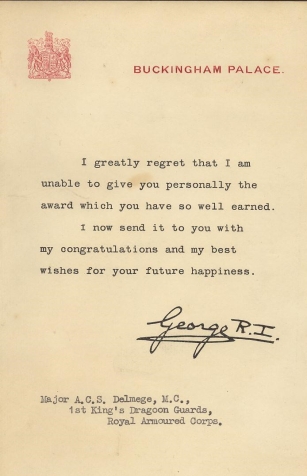
Anthony Charles Stuart Delmege was born on 1 December 1910, the son of Major Carfrae Hamilton Delmege and Rose Eccles.
As the first qualifying male descendant of John Stewart (or Stuart) Eccles through his daughters, he became:
Tenant in tail male in possession of the Ecclesville estate
He pursued a military career:
- Colonel, 1st King’s Dragoon Guards (Special Reserve)
- Served as Aide-de-Camp to the Governor of Madras
He never married and died on:
22 July 1961, aged 50.
Return to Ecclesville (1951)
In 1951, Colonel Delmege visited Ecclesville, a symbolic return to the ancestral estate.
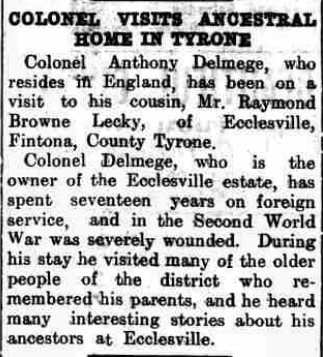
This visit was noted in the Londonderry Sentinel (1 September 1951), reflecting the continued association of the family with the property, despite its diminished extent.
Legal Vesting of the Estate (1944)
The continued operation of the Eccles entail is clearly demonstrated in the following Memorial of Indenture (1944), which confirms Anthony Charles Stuart Delmege as:
tenant in tail male in possession
Memorial of Indenture (7 February 1944)
(Registered 22 February 1944, Registry of Deeds, Belfast)
A Memorial of an Indenture dated the Seventh day of February one thousand nine hundred and forty four made between Anthony Charles Stuart Delmege of the Manor House, Cricklade in the County of Wilts a Major in His Majesty’s Army of the one part and Robert McLraith Blakeney of 25 Clare Street in the City of Dublin Solicitor of the other part.
Reciting that under the will dated 1 October 1873 and codicil dated 2 April 1886 of John Stuart Eccles of Ecclesville, the hereditaments therein described were settled to uses under which the said Anthony Charles Stuart Delmege was tenant in tail male in possession.
It was witnessed that the said Anthony Charles Stuart Delmege granted unto the said Robert McLraith Blakeney and his heirs all the lands comprised in the said settlement (except such parts as had been sold), to hold the same freed from the estate tail and all remainders, to the use of the said Anthony Charles Stuart Delmege in fee simple.
Lands Comprising the Estate
The deed recites the surviving lands of the Ecclesville estate, including:
- Ecclesville
- Fintona
- Castletown
- Corbally
- Drumlaghan
- Dungoran
- Lisnagardy
- Skelgagh
- Tullyrush
- Tattymoyle
- and numerous other townlands within the parish of Donacavey
These lands represent what remained of the estate following earlier sales under the Land Acts.
Financial Schedule Attached to the Deed
The 1944 memorial also records financial assets associated with the estate at the time, including government securities and railway stock:
- £2020 — 4½% Land Bonds
- £4727 13s 8d — War Loan (3½%)
- £312 12s 3d — War Loan (3½%)
- £4 13s 0d — War Loan (3½%)
- £100 11s 1d — War Loan (3½%)
- £12071 11s 4d — 2½% Consols
- £61 — London Midland & Scottish Railway 4% Stock
- £50 — Great Southern Railway (Ireland) 4% Guaranteed Preference Stock
- £100 11s 1d — War Loan (3½%)
These entries reflect the conversion of landed wealth into financial assets, a common feature of estates following the sale of lands under the Irish Land Acts.
Significance of the 1944 Deed
This deed is of particular importance, as it shows:
- The final legal operation of the Eccles entail
- The conversion of the estate from entailed property to fee simple ownership
- The reduced extent of the estate following its break-up
It marks the transition from:
hereditary settlement → modern ownership
Relationship to the Break-Up of the Estate
By the time of the Delmege inheritance:
- The greater part of the estate had already been sold
- Only a reduced core remained under family control
The Delmege succession therefore represents:
the legal conclusion of the Eccles entail, rather than the continuation of the estate in its original form
→ See: The Break-Up of the Ecclesville Estate
Historical Significance
The Delmege inheritance illustrates:
- The long-term effects of strict settlement and entail
- The survival of legal structures long after estates had declined
- The eventual transition from landed estate to modern property ownership
It represents the final stage in the history of the Ecclesville estate as a hereditary property.
See Also
- John Stuart Eccles and the Ecclesville Entail
- Amy Henrietta Frances Eccles McClintock
- Break-Up of the Ecclesville Estate
- Abstract of Title – Ecclesville Estate (1913)
- The Eccles Family of Ecclesville
- Browne-Lecky Family
- Knox-Browne of Aughentaine Castle
- McClintock of Seskinore
- The Delmege Family and the Connection to Anthony Charles Stuart Delmege