Overview
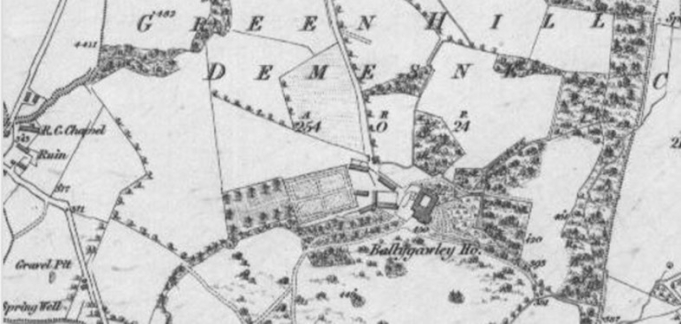
Ballygawley Park: Sale, Fire and Demolition
Overview
Ballygawley Park, County Tyrone, was for much of the nineteenth century the principal seat of the Stewart baronets of Athenree. Developed from earlier lands associated with the Plantation period, the estate became one of the principal landed properties in the Ballygawley district before entering a long period of decline that culminated in its sale, partial demolition, and destruction by fire in the early twentieth century.
The history of Ballygawley Park reflects the wider story of the Irish landed estate system: expansion during the eighteenth and nineteenth centuries, financial pressure and restructuring during the Victorian era, and eventual fragmentation after the First World War.
Early History of Ballygawley
At the time of the Plantation of Ulster, Ballygawley was known by several earlier names, including:
- Moyenner
- Ballegalin
- Cavanballygallin
In the early seventeenth century, Captain William Turvin received a grant of lands at Ballygawley from King James I. Turvin failed to fulfil the conditions of plantation, and the property subsequently passed into the hands of:
- Sir Gerald Lowther
- the Hamilton family
- later the Beresford family
- and eventually the Stewart family
A contemporary survey by Sir Josias Pynnar recorded the early Plantation settlement and defensive structures at Ballygawley.
By the nineteenth century, the estate had become associated with the Stewart family of Athenree.
Stewart Ownership and Development
Acquisition by the Stewart Family
The property known as Greenhill, near Ballygawley, was acquired by:
Sir John Stewart, 1st Baronet of Athenree
c.1810–11.
The estate had previously been occupied by:
Thomas Harvey Esq.
who later settled in Newry, County Down.
Sir Hugh Stewart and the Creation of Ballygawley Park
Sir Hugh Stewart, 2nd Baronet (1792–1854)
greatly developed the property and transformed Greenhill into:
Ballygawley Park
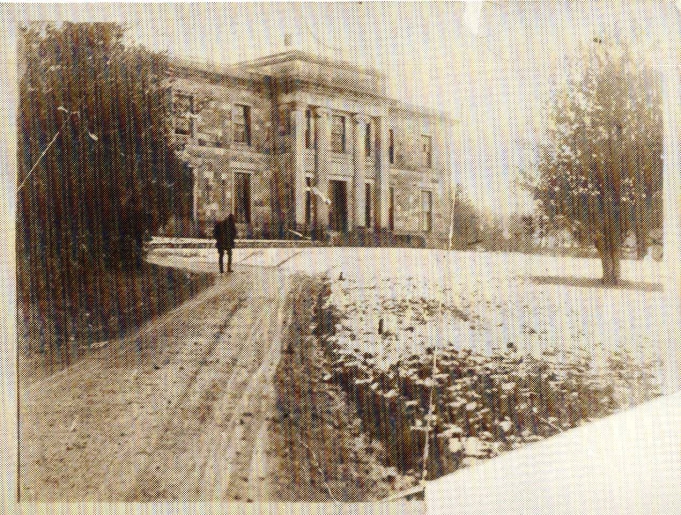
A substantial mansion house was constructed c.1825–33 to designs attributed to:
John Hargrave of Cork
using locally quarried freestone.
At the same time, the Stewart family also maintained another residence at:
- Loughmacrory Lodge
Financial Pressure and Estate Sale
Sale Advertisement (1854)
In September 1854, the Ballygawley estate, amounting to approximately 5,440 acres, was advertised for sale.
The advertisement described:
- Ballygawley House and offices as being in excellent modern condition
- a substantial rental income
- and the estate as one of the most desirable properties in County Tyrone
The sale included:
- the house
- demesne
- townlands
- and extensive agricultural lands
Death of Sir Hugh Stewart
Sir Hugh Stewart, 2nd Baronet, died on:
19 November 1854
shortly after the estate sale process had begun.
Incumbered Estates Court Records (1855)
A record preserved at:
PRONI — D4183/23/6
dated 18 January 1855
details the Stewart estate in County Tyrone.
The document refers to:
“The rental and particulars of sale of lands for the estate of Sir Hugh Stewart and John Marcus Stewart in County Tyrone…”
The townlands listed include:
- Gortigal
- Aghalarg
- Gortatray
- Edergole
- Kiltamnagh
- Stroancarbadagh
- Tullycunny
- Rakeeragh
- Creevanmore
- Drudgeon
- Blacksessogue
- Lisanelly
- Altcloghfin
- Martray
- Coolagerry
- Killyneery
- Armalughey
- Cravenny Scotch
The record further notes that:
“Included are maps of the properties for sale.”
These records illustrate the financial pressures affecting the estate during the mid-nineteenth century and form part of the wider restructuring of Irish landed property during this period.
Sir John Marcus Stewart and Continued Development
Following the death of:
Sir Hugh Stewart, 2nd Baronet,
on 19 November 1854,
the estate and baronetcy passed to his eldest surviving son:
Sir John Marcus Stewart, 3rd Baronet
(1830–1905)
Sir John Marcus Stewart continued the development and management of the Ballygawley estate during the later nineteenth century.
Estate Improvements (1871)
In 1871, substantial building works were undertaken at Ballygawley Park.
A notice published in the Belfast News-Letter announced proposals for:
- the erection of a farmstead
- alterations and additions to stables and offices
- and the construction of three dwelling houses at Ballygawley
The notice stated:
NOTICE TO BUILDERS
“PROPOSALS WILL BE RECEIVED FOR the erection of a FARMSTEAD, together with Alterations and Additions to the STABLE, OFFICES, and other Works at BALLYGAWLEY PARK, County Tyrone, the seat of Sir John Marcus Stewart, Bart.”
“Also, for the erection of THREE DWELLING HOUSES at BALLYGAWLEY…”
“According to Plans and Specifications to be seen at the Offices of FITZGIBBON LOUCH, Esq., C.E., Architect, 45 Donegall Place, Belfast…”
“The lowest or any Tender will not necessarily be accepted.”
— Belfast News-Letter, 9 May 1871
The works demonstrate that, despite the financial pressures affecting many landed estates during the nineteenth century, Ballygawley Park continued to receive substantial investment under Sir John Marcus Stewart.
The involvement of a Belfast architect and the scale of the improvements suggest that the estate remained an important and active landed property during this period.
Ballygawley in 1904
A detailed article published in the Fermanagh Herald in January 1904 by John Dorrian provides a vivid contemporary account of Ballygawley during the later Stewart period.
Dorrian reflected both on the long history of Ballygawley and on the decline in population and prosperity that had occurred during the nineteenth century.
He observed that:
“Some years ago [the town was] close upon 1,000; and to-day we number, all told, little more than one-fourth of that.”
The article traced the history of the district from the Plantation period through the ownership of:
- Lowther
- Hamilton
- Beresford
- and Stewart families
Dorrian also recorded that by 1904:
“Sir John does not now reside at Ballygawley Park though there is a caretaker at the place, and his permanent residence is at Carrickmore Hall…”
This is significant, as it demonstrates that Ballygawley Park had already ceased to function as the principal Stewart residence before the death of Sir John Marcus Stewart in 1905.
The Final Occupation of Ballygawley Park
The 1901 and 1911 Irish census returns show that Ballygawley Park was maintained largely through resident caretakers during its later years.
The caretaker and gardener recorded at the property was:
Joseph Somerville
In 1911 he was additionally described as:
“Pensioner from Regiment 27th Inniskilling Fusiliers.”
The household recorded in 1911 included:
- Joseph Somerville
- Bridget Somerville
- Susan Somerville
- Mary Ellen Somerville
- Bridget Somerville
- Joseph Somerville (junior)
- Elizabeth Somerville
- Bernard McCavana (boarder)
These records provide a rare glimpse into the final inhabited phase of the estate before its disposal and destruction.
Sale, Fire and Final Destruction
Disposal of Ballygawley Park (1918)
In 1918:
Sir Hugh Houghton Stewart, 4th Baronet
disposed of Ballygawley Park to:
Mr Hugh M’Laurin, J.P.,
of Messrs M’Laurin Bros., Belfast,
for:
£6,000
The purchaser never occupied the mansion house.
Demolition and Removal of Materials
By 1920, advertisements appeared inviting tenders for the removal of building materials from the mansion.
The notice referred to the large quantities of:
- cut stone
- slate
- lead
- and teak wood
used in the construction of the house.
The buildings were to be removed by January 1921.
Dispute Following the Sale
Although Sir Hugh Stewart had disposed of the estate in 1918, a dispute subsequently arose regarding auctioneers’ fees and expenses connected with the transaction.
The matter continued unresolved for several years and was only formally settled in February 1922.
A report in the Northern Whig recorded proceedings before the King’s Bench in Dublin involving:
- John and William M’Cann, auctioneers, Aughnacloy
- and Brigadier-General Sir Hugh Houghton Stewart, Bart.
The action concerned commission and expenses arising from the sale of Ballygawley Park.
The report stated that:
“The defendant undertook to pay £120 in full discharge of plaintiffs’ claim…”
The proceedings demonstrate that financial and legal matters connected with the disposal of the estate remained unsettled even after the property had passed from Stewart ownership.
Destruction by Fire (1922)
On:
17 February 1922
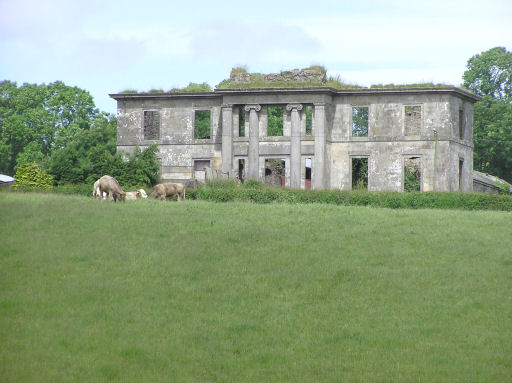
the mansion at Ballygawley Park was destroyed by fire.
A report in the Belfast News-Letter described the event under the headline:
“Tyrone Incendiarism — Mansion Gutted Near Ballygawley”
The newspaper reported:
“A fine old mansion at Greenhill… was maliciously set on fire yesterday morning and reduced to ashes.”
The building was described as:
- unfurnished
- unoccupied
- and standing within its own demesne about a mile from Ballygawley.
The article noted that the property:
“was formerly the seat of the Stewarts, Co. Tyrone, and was sold in 1918… for £6,000.”
Rumours of Crown Occupation
At the time of the fire, rumours had circulated that Crown forces or the RIC might take over the building for use as barracks.
The newspaper stated that police had recently inspected the property:
“with a view to that purpose.”
It was widely believed locally that the fire was connected to these rumours and that the destruction of the house prevented any possible military occupation.
Although responsibility was commonly attributed to the IRA, no formal public claim appears to have been made.
Circumstances of the Fire
Contemporary reports described:
- quantities of hay soaked in petrol placed throughout the house
- petrol tins discovered within the building
- and the rapid spread of the flames before dawn.
Local Specials and RIC officers who attended the scene were unable to save the building.
Compensation Claim and Local Suspicion
Only days after the fire, a claim for:
£20,000
was lodged in connection with the destruction of the mansion.
The speed and scale of the claim attracted local comment and speculation, particularly as the property had reportedly been purchased for only £6,000 a few years earlier.
While no evidence emerged publicly to contradict the official interpretation of the fire as malicious destruction, rumours persisted locally that there may have been more to the circumstances surrounding the destruction of Ballygawley Park.
Final Disposal
Following the fire, the remains of the mansion and demesne were sold.
The destruction of Ballygawley Park marked the final end of the estate as a major landed seat of the Stewart family in County Tyrone.
See Also:
- The Stewart Family of Athenree, Ballygawley and Loughmacrory
- The Stewart Baronetcy of Athenree: Genealogical Register
- Loughmacrory Lodge and the Later Stewart Family
- Sir John Marcus Stewart: Obituary and Public Life