
Amy Henrietta Frances Eccles McClintock (1874–1942)
Life Tenant of Ecclesville and the Transition of an Estate
Origins and Family Background
Amy Henrietta Frances Eccles was born on:
22 April 1874
the eldest daughter of:
John Stewart (or Stuart) Eccles
of Ecclesville
and:
Frances Caroline Browne
of Aughentaine Castle.
She belonged to a network of interrelated landed families including:
- Eccles of Ecclesville
- Browne of Aughentaine
- de Montmorency of Castle Morres
- Browne-Lecky
- McClausland of Drenagh
- McClintock of Seskinore
Following the death of her father in 1886, and her mother in 1887, Amy and her sisters were left orphaned at a young age.
The Amy Eccles Presentation Cup (1875)
A Family Presentation Piece
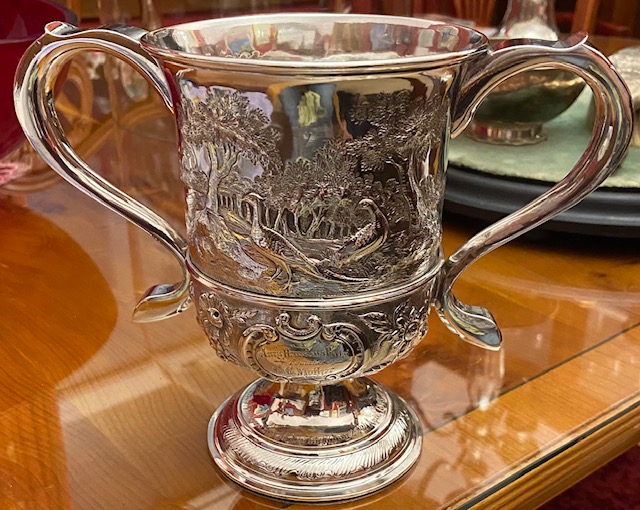
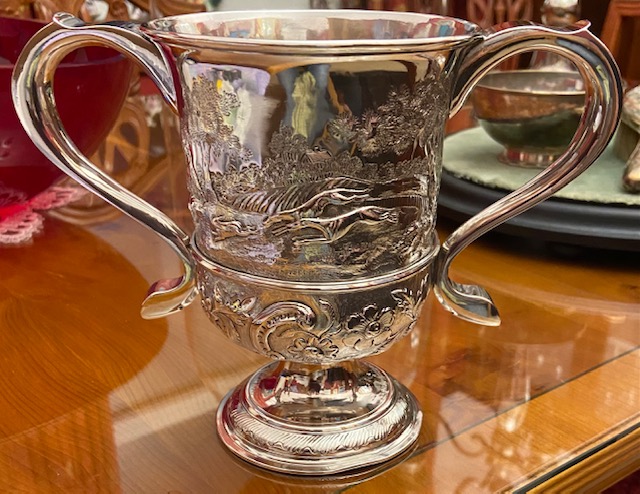
This silver presentation cup was given to:
Amy Henrietta Frances Eccles
(1874–1942)
by her great-grandmother:
Jemima Eccles (née Dickson)
who died 19 April 1879.
The cup bears the inscription:
“To Amy Henrietta Eccles
From her G G mother
On the Anniversary of her birthday, 22nd April 1875.”
The gift was presented on the occasion of Amy’s:
- first birthday anniversary,
Guardianship and Upbringing
Guardianship of Amy and her sisters:
- Rose Isabel Eccles
- Anna (“Dosie”) Eccles
was entrusted to:
Dr Edward Charles Thompson of Omagh
together with trustees connected to the Browne-Lecky family.
Dr Thompson was both:
- a close blood relative through the Blake family of Castle Grove
- later brother-in-law to John Knox McClintock
Amy and her sisters were subsequently raised within the household of their aunt and uncle:
Annie Eccles and Conolly Browne-Lecky
at:
- Ecclesville
- later Fintimara, Warrenpoint
within a stable and well-connected family environment.
Heiress Under Entail
Under the will of her father:
John Stewart (or Stuart) Eccles
(d. 1886)
the Ecclesville estate was:
strictly entailed in tail male
As a consequence:
- Amy became life tenant and beneficial heir
- but not absolute owner in fee simple
This distinction proved critically important.
Although Amy inherited possession and income from the estate, her control lasted only for her lifetime. The inheritance itself was legally directed toward the nearest qualifying male heir under the terms of the entail.
Marriage and Family
On 26 April 1893, Amy Henrietta Frances Eccles married John Knox McClintock of Seskinore.
The marriage united two of the most prominent landed families in west Tyrone: the Eccles family of Ecclesville (c. 9,227 acres) and the McClintock family of Seskinore (c. 4,553 acres).
The match was:
- Socially aligned
- Geographically strategic
- Reinforced by prior family connections
Given the role of Dr Edward Charles Thompson—both Amy’s guardian and McClintock’s brother-in-law—it is likely the marriage arose within an already established network of family relationships.
The couple had one child:
Amelia Isobel Eccles McClintock (“Leila”)
21 July 1898 – 30 January 1937
Leila later married Captain Wilfred Heyman (“Tony”) Joynson-Wreford and was the mother of Penelope (“Xenia”) Joynson-Wreford.
Through her daughter and granddaughter, Amy became the link between the Eccles, McClintock and Joynson-Wreford families.
Issue
Amy and John Knox McClintock had one child:
- Amelia (“Leila”) Isobel McClintock (b. 21 July 1898)
No male heir was born, a fact which had major implications under the terms of the Eccles entail.
The 1903 Entail Clarification
In 1903, John Knox McClintock sought legal clarification regarding the future of the Ecclesville estate.
The outcome confirmed:
- Amy held the estate for life only
- In the absence of a son, succession would pass through the male line of her sisters
Her daughter, Leila, would receive only:
- £3,000 provision, rather than the estate itself
This formalised the reality that the estate would ultimately leave Amy’s direct line.
Estate Management and the Land Acts
During Amy’s tenure, major structural changes took place across Ireland under the Irish Land Acts.
As a result:
- Most of the Ecclesville estate was sold to tenants
- Only the demesne (c. 206 acres) was retained
This marked the effective end of Ecclesville as a traditional landed estate.
In 1898, Inland Revenue records show Amy Eccles as successor to the Ecclesville estate, comprising extensive lands across Donacavey with an annual valuation of £4,886.
Transfer of the Demesne
The transfer of the remaining Ecclesville demesne to Amy’s Browne-Lecky relatives formed part of a wider pattern of inheritance within the interconnected Eccles, Browne-Lecky and de Montmorency families.
Probate records of Conolly William Lecky Browne-Lecky, proved in 1924, show his principal heir to be his son, Raymond Saville Conolly de Montmorency Lecky Browne-Lecky, who subsequently became the final private owner of Ecclesville.

Ecclesville
The Ecclesville demesne remained one of the last surviving portions of the original estate following the widespread sales under the Land Acts.
Although greatly reduced in size, the house and demesne retained considerable historical significance within the family network and later formed part of the Browne-Lecky inheritance.
Personal Crisis and Exile
Around 1916, Amy’s marriage broke down following a widely recounted personal scandal.
As a result:
- She was excluded from Ecclesville and family life
- She left Ireland and settled in England
- She did not appear to have returned to Ireland during her husband’s lifetime
Amy’s Will and Probate
On 15 February 1929, Amy Henrietta Frances Eccles McClintock executed her last will and testament.
In the will she left all her real and personal property to her only child:
Amelia Isobel Eccles McClintock (“Leila”)
absolutely, and appointed Francis Samuel DuBedat Colquhoun, solicitor of 25 Clare Street, Dublin, as sole executor.
The arrangements made in 1929 were overtaken by a series of family tragedies. Leila died on 30 January 1937, more than five years before her mother, while Captain Wilfred Heyman (“Tony”) Joynson-Wreford, who had proved Leila’s will, died on 23 March 1940.
When Amy herself died at Molstyn, Orestan Lane, Effingham, Surrey, on 4 April 1942, both her daughter and son-in-law were already deceased. Administration of her estate therefore required a more complex probate process involving representatives of the Joynson-Wreford estate.
The probate papers identify Amy’s granddaughter, Penelope (“Xenia”) Joynson-Wreford, as the surviving issue of Leila and therefore the final living descendant of Amy’s direct line.
These records provide a poignant illustration of the succession crises that affected both the McClintock and Joynson-Wreford families during the late 1930s and early 1940s.
Later Years, Family Tragedy and the End of the Seskinore Line
After the breakdown of her marriage and her departure from Ireland, Amy Henrietta Frances Eccles McClintock spent much of her later life in England.
She eventually settled at Molstyn, Orestan Lane, Effingham, Surrey, where she lived close to members of her wider family, including her niece Rose Kathleen Sugden (née Stoney), daughter of her sister Anna Theodosia Hester (“Dosie”) Stoney.
Despite her separation from Seskinore, Amy remained closely connected with the future of the estate through her daughter, Amelia Isobel Eccles McClintock (“Leila”), and granddaughter, Penelope (“Xenia”) Joynson-Wreford.
The Death of Colonel John Knox McClintock
On 24 October 1936, Colonel John Knox McClintock died at Seskinore.
Under the terms of the McClintock marriage settlement of 26 April 1893, the remaining settled estate passed to Leila, the only child of the marriage.
For a brief period it appeared that a new generation of the family might re-establish itself at Seskinore. Family recollections suggest that plans were already underway for Leila, Tony Joynson-Wreford and their young daughter Xenia to make their home there.
Leila’s Death
These hopes were short-lived.
Only a few months after inheriting the estate, Leila contracted meningitis and died on 30 January 1937 at the age of thirty-eight.
Her death devastated the family and marked a major turning point in the history of Seskinore.
According to later accounts, Tony struggled profoundly with the loss. Leila was ultimately buried within the small garden she had created as a child on the estate, later known as the Garden of Remembrance.
At her funeral, the following tribute was read:
“As a little girl, she made a garden on this site. With her own little hands she planted flowers here, and with childish interest and delight, looked after them. That spot, made sacred by her associations with it when she was a child is now to be sanctified by her abiding presence.”
(Tyrone Constitution, 5 February 1937.)
The Final Succession of Seskinore
Under her will dated 22 January 1935, Leila left her real and personal estate absolutely to her husband, Captain Wilfred Heyman (“Tony”) Joynson-Wreford.
The Settlement and Conveyance documents executed during 1937–1938 completed the transfer of the remaining estate to Tony and formally wound up the marriage settlement established upon Amy’s marriage in 1893.
Under the original settlement Amy was entitled to a jointure of £300 per annum. During the final reorganisation of the estate this entitlement was commuted for a lump-sum payment of £3,703 15s, and she formally released her claims under the settlement.
These documents placed Amy at the centre of the final legal transition of Seskinore from the McClintock family into the Joynson-Wreford line.
Final Years and Death
Following these events Amy returned to Surrey, where she continued to live quietly at Effingham.
She died on 4 April 1942 and was buried at St Lawrence Churchyard, Effingham.
Eighteen years later her sister, Anna Theodosia Hester Stoney (“Dosie”), was buried beside her.
Their shared memorial bears the inscription:
IN LOVING MEMORY OF
AMY HENRIETTA MCCLINTOCK
WHO PASSED AWAY APRIL 4TH 1942
AND OF HER SISTER
ANNA THEODOSIA HESTER STONEY
WHO WENT TO HER REST JULY 8TH 1960
LIFE IS ETERNAL AND LOVE IMMORTAL

The inscription reads:
Historical Significance
Amy Henrietta Frances Eccles McClintock represents a pivotal transitional figure in the history of the Ecclesville estate.
Her life illustrates:
- The limitations imposed by strict entail
- The role of female heirs as life tenants rather than owners
- The impact of the Irish Land Acts in dismantling landed estates
- The importance of family networks in marriage and inheritance
Although she stood at the centre of one of Tyrone’s most significant estates, the legal and social structures of her time ensured that its long-term future lay beyond her direct line.
See Also
- John Stewart (or Stuart) Eccles and the Ecclesville Entail
- Will of John Stewart (or Stuart) Eccles (1873)
- Browne-Lecky family
- The Eccles Family of Ecclesville
- Marriage Settlement of John Knox McClintock & Amy Henrietta Eccles
- Dr. Edward Charles Thompson (1852–1935)
- The Break-Up of the Ecclesville Estate
- The Delmege Inheritance: Ecclesville Estate and Cricklade Manor
- Abstract of Title – Ecclesville Estate (1913)
- Will of Amy Henrietta Frances Eccles McClintock (1929; proved 1947).
- Leila McClintock: The Final Generation
- Penelope (“Xenia”) Xenia Joynson-Wreford