This section brings together the history, development, and ownership of the estates associated with Seskinore, Mullaghmore, and Ecclesville. It includes timelines, legal history, and the transition of land through different families.
Explore this section
- The Plantation of Ulster and the Origins of the Seskinore Estate
- Abstract of Title for the Seskinore Estate
- The Perry family of Mullaghmore, Perrymount and the Origins of the Seskinore Estate
- McClintock of Seskinore: Pedigree (Perry Descent to Xenia Joynson-Wreford)
- Ecclesville Estate
- Ownership Timeline
- 1940 Conveyance to The Ministry of Agriculture

Seskinore Estate
The Seskinore estate, situated in County Tyrone, formed the principal seat of the McClintock family from the mid-nineteenth century and represents the central thread in the history of the McClintock of Seskinore line.
Its origins, however, lie earlier in the development of the Mullaghmore (Perrymount) estate, established by the Perry family in the seventeenth century. Through marriage and inheritance, the estate passed into the McClintock family and remained associated with them, and their successors, into the twentieth century.
Unlike some contemporary estates, Seskinore was not dismantled through legal processes, but gradually declined through a combination of personal circumstance, economic change, and eventual sale.
Origins: Mullaghmore and the Perry Family
The foundations of the Seskinore estate lie in the lands of Mullaghmore (later known as Perrymount), which were associated with the Perry family from the seventeenth century.
These lands formed the early core of the estate and established a pattern of landholding that would later pass, through marriage, into the McClintock family.
Explore:
The McClintock Inheritance
The connection between the Perry and McClintock families was established through the marriage of Alexander McClintock of Newtown to Mary Perry in 1781.
The transfer of the estate itself, however, occurred later and was governed by the will of George Perry (1823), which directed its succession to the McClintock line.
In 1845, Samuel McClintock took possession of the estate at Seskinore, establishing it as the principal residence of the family.
See: Will of George Perry (1823) and Transfer of the Estate
In 1845, Samuel McClintock took possession of the estate at Seskinore, establishing it as the principal residence of the family.
In the early nineteenth century, a residence was established at Seskinore, most likely constructed by George Perry between c.1800 and 1812 as part of a wider programme of estate development.
Following the transfer of the estate to the McClintock family, the house was adopted and further developed as the principal residence.
By the mid-nineteenth century, the estate comprised several thousand acres and formed a significant local presence in County Tyrone.
- Perry–McClintock Ownership Timeline
- Family Network and Succession of the Mullaghmore and Seskinore Estates
Development and Remodelling of Seskinore House
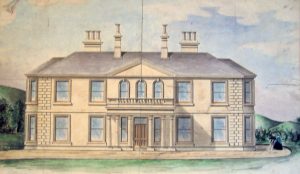
Architectural Development
The architectural history of Seskinore House reflects multiple phases of construction and alteration.
The original house was most likely built by George Perry in the early nineteenth century, following the consolidation of the estate and his residence there by 1812.
This early house formed the basis for later enlargement and remodelling carried out under the McClintock family.
It has been suggested—most notably by local historian Dr. Haldane Mitchell—that Seskinore House may have been remodelled to designs by the architectural firm Lanyon & Lynn, one of the most prominent practices in nineteenth-century Ulster.
However, no documentary evidence has yet been identified to substantiate this attribution.
By contrast, there is clear evidence of significant works carried out in the mid-nineteenth century.
The Boyd & Batt Remodelling (c.1862)
Around c.1862, Seskinore House underwent a major transformation.
The house was remodelled and extended to designs by the Londonderry and Belfast architectural firm Boyd & Batt, resulting in a substantial Victorian residence of considerable scale and status.
Following these works, the house comprised:
- Five principal reception rooms
- Ten bedrooms
- Extensive staff accommodation
- A separate residence for the butler
This phase represents the most clearly documented architectural development of the house.
Later Alterations
The building did not remain static. Further alterations were carried out during the ownership of Colonel John Knox McClintock.
Photographic evidence clearly demonstrates changes to the structure and appearance of the house, indicating that the building continued to evolve beyond the mid-nineteenth century works.
These later modifications appear to have included:
- Alteration of the principal (front) elevation, including the addition of a porte-cochère
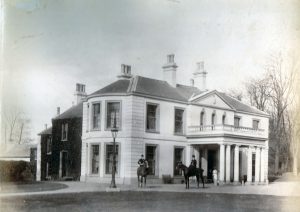
- Extension and raising of the side elevation, most likely in the late nineteenth century

Reshaping the Demesne (c.1860s)
The remodelling of the house was accompanied by a wider transformation of the estate landscape.
At the same time:
- The main road was rerouted
- Additional land was enclosed into the demesne
- The estate was reorganised into a more formal and controlled layout
New service buildings were constructed, including:
- Courtyards
- Stables
- Barns
- Kennels
- Estate offices
Together, these changes reflect the evolution of Seskinore into a fully developed Victorian estate, combining residential, agricultural, and sporting functions.
Interpretation
While the involvement of Lanyon & Lynn remains unproven, the documented work of Boyd & Batt firmly places Seskinore within the broader pattern of mid-19th century estate improvement in Ulster.
The scale of the works suggests not merely alteration, but a deliberate effort to modernise and elevate the house in line with contemporary expectations of status, efficiency, and display.
- The 1862 remodelling of Seskinore House
- Estate buildings, courtyards, and the walled garden
Estate Life at Seskinore
Life at Seskinore reflected the character of a resident landed estate. The McClintock family maintained a strong local presence and were actively involved in both estate management and community life.
The men of the family frequently pursued military careers, serving in regiments such as the Royal Inniskilling Fusiliers. At home, the estate supported a substantial workforce, including domestic staff, gardeners, and farm labourers.
Sporting life was also central to the estate’s identity. The Seskinore Harriers, established as a private pack in 1860, were closely associated with the family and remained an important feature of local life for many years.
Read more:
Transition to the 20th Century
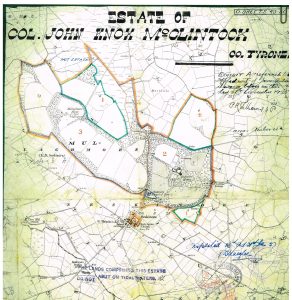
Transition to the Twentieth Century
Following the death of George Perry-McClintock in 1887, the estate passed to his son, Colonel John Knox McClintock.
Although the marriage of John Knox McClintock and Amy Henrietta Frances Eccles in 1893 brought the Seskinore and Ecclesville families into close association, the two estates remained legally distinct.
Seskinore passed through the McClintock line and subsequently to the Joynson-Wreford family. Ecclesville, by contrast, was governed by a strict entail in tail male and did not pass to the McClintocks, instead descending to the next heir in the male line.
Had a male heir been born to the marriage of John Knox McClintock and Amy Eccles, the two estates would have been united; in the absence of such an heir, they followed separate lines of succession.
See: Will of John Stuart Eccles and the Entail of Ecclesville
This period marked both continuity and change. While the estate remained active and socially prominent, new legal arrangements governing inheritance, together with increasing economic pressures, would shape its future.
See also:
- John Knox McClintock & Amy Eccles
- Ecclesville House, Fintona, County Tyrone
- The death of Colonel McClintock (1936)
Decline and End of the Estate
The later history of Seskinore reflects a gradual process of decline rather than a single defining event.
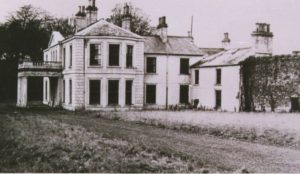
Following the deaths of Colonel John Knox McClintock (1936), Leila McClintock (1937), and Captain Joynson-Wreford (1940), the estate passed into trusteeship. In 1941, Seskinore House and its demesne were sold to the Ministry of Agriculture, bringing to an end the estate as a private family residence.
The house itself was later demolished in 1952, marking the disappearance of the architectural centre of the estate.
Explore:

Character of the Estate
Seskinore differed in important respects from other estates of the period.
While many estates were broken up through legal mechanisms and land reform, Seskinore passed largely through family succession before ultimately being reduced through sale in the twentieth century.
Its history is therefore defined as much by continuity and inheritance as by its eventual decline.